
Evaluating modern SEC reporting software is a top priority for finance leaders looking to eliminate the manual chaos of peak filing season. Every financial reporting team shares a variation of the exact same crunch-time story:
The Form 10-K is nearly complete. Finance has signed off on the balance sheet, Legal has fine-tuned disclosures, and Investor Relations is aligning executive messaging. Then, late in the review window, a last-minute audit adjustment alters a single line item.
What should be a routine numerical update turns into hours of manual labor across Word documents, Excel workbooks, cross-referenced footnotes, and iXBRL tagging. One minor update ripples through the entire SEC filing.
The filing still gets submitted, it almost always does. The real question is: how much operational friction, team burnout, and cost did it take to get over the finish line?
For many public companies, SEC reporting processes remain one of the most manual finance processes despite years of investment in ERP systems, consolidation tools, and close automation. Last-mile reporting often depends on disconnected spreadsheets, document versions, email approvals, and repetitive validation work. Teams spend more time protecting the filing from human error than improving disclosure quality.
Legacy SEC reporting software environments have fundamentally structured their commercial models around complexity. They treat your external reporting lifecycle as a series of billing events, charging premiums for last-minute XBRL changes, tying up your team in cumbersome document-checking workflows, and demanding manual intervention to ensure numbers tie across the 10-K, proxy statement, and earnings release.
That reality is changing. offering an operational layer that unifies financial data, narrative disclosures, data collection, review workflows, and regulatory validation into a single streamlined process.
Modern SEC reporting software is no longer designed simply to generate filings. It is becoming the operational layer that connects financial data, disclosure narratives, review workflows, regulatory validation, and filing readiness into a single process.
The Hidden Cost of Manual Reporting
Finance leaders often calculate SEC reporting costs based on software licensing or external filing services.
That misses the larger operational expense. The real costs include:
| Hidden Cost | Operational Impact |
| Manual Reconciliations | Additional review cycles before filing |
| Version Confusion | Duplicate work across teams |
| Spreadsheet Dependency | Higher risk of formula and linking errors |
| Repeated Quality Checks | Senior finance staff diverted from analysis |
| Late-stage Corrections | Filing delays and increased audit pressure |
| External Support | Higher vendor costs during peak periods |
Manual processes cost more than time and money. They chip away at governance, make reporting harder to trust, slow everything down, and wear on the team doing the work. Once people stop trusting the numbers coming out of a manual process, filing deadlines start feeling less like targets and more like threats.
Here’s the upside: AI gives finance teams a way out. Automate the repetitive stuff, tighten up controls, and the whole reporting process gets more reliable and a lot less painful to manage.
Deconstructing the AI-First Paradigm in Disclosure Management
An AI-first approach to a sec reporting software environment reverses this dynamic. Instead of relying on human eyes to verify data lineage and taxonomy alignment, the core platform natively parses the relationships between your data points, the narrative text, and the active regulatory taxonomies.
For senior leadership, this technical shift delivers specific operational advantages:
| Operational Metric | Legacy Systems Architecture | AI-First Architecture (IRIS CARBON) |
| XBRL Tagging & Mapping | Manual matching, high reliance on third-party service desks. | Automatedns. |
| Data Lineage | Disconnected data layers; manual copy-pasting across documents. | Single source of truth; programmatic updates across all filing components. |
| Filing Predictability | Batch validation runs that catch errors late in the review cycle. | Continuous, background validation against active SEC rulebooks. |
| Error & Anomaly Detection | Reviewers manually cross-check numbers, references, and prior-year figures, often catching mismatches only at final review. | AI flags cross-reference gaps, prior-year misalignments, and unit or terminology inconsistencies as the filing is built. |
| Disclosure Drafting | Analysts write MD&A, risk, and business sections from scratch each cycle, with heavy manual editing. | AI generates first drafts for MD&A, risk, and business updates, so teams edit and refine instead of starting blank. |
| Regulatory Benchmarking | Compliance checked manually against standards, often reactively after a regulator or auditor flags a gap. | Disclosures scored against standards item by item, with peer benchmarking built in. |
What Modern SEC Reporting Software Should Automate
Automation should reduce repetitive work without removing professional judgment.
The strongest SEC filing software solutions automate operational tasks while leaving while leaving key disclosure requirements and risk management decisions in the hands of finance leaders:
Core automation areas include:
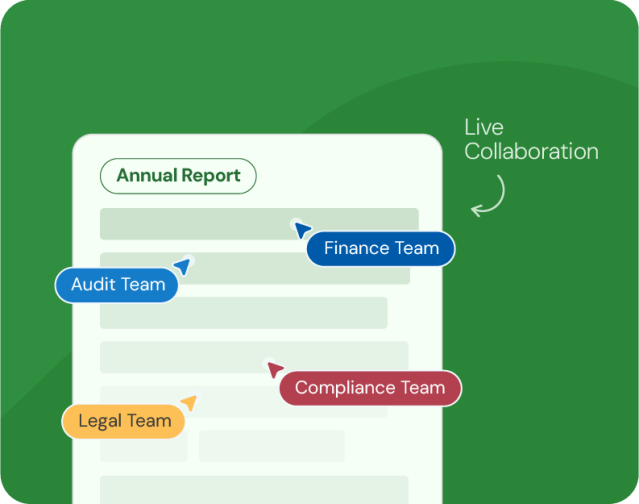
1. Intuitive Disclosure Management
Your software should allow multiple authors to work on different sections of a Form 10-K or Form 10-Q simultaneously without locking each other out. Look for platforms that support deep integrations with Excel and Word, ensuring your source data links directly to your final disclosures.

2. Data Synchronization
Numbers should update automatically wherever they appear in the filing. Manual copy-paste remains one of the largest sources of reporting inconsistency.
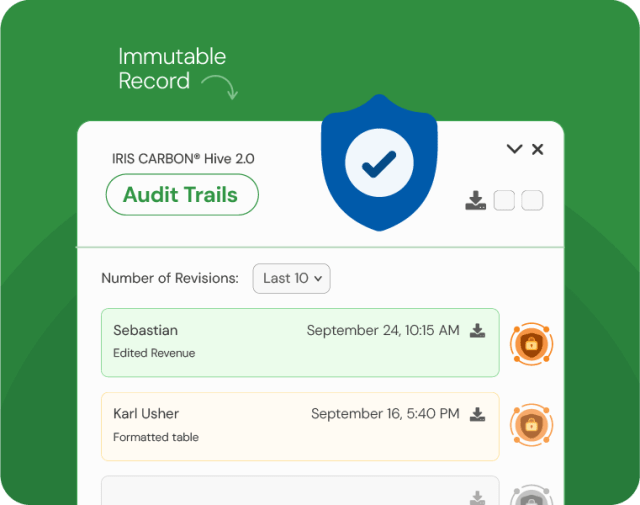
3. Bulletproof Audit Trails
Who changed that revenue number in Note 3? When was it changed? Your platform must maintain a transparent, granular history of edits to satisfy internal controls and external auditors.

4. High-Accuracy iXBRL Capabilities
Inline XBRL (iXBRL) is non-negotiable under SEC rules, and the taxonomy changes every year. The software should be the one that keeps up with that, not your team. Look for a platform that handles the heavy lifting of taxonomy mapping, so your finance team does not have to become overnight XBRL experts.
The AI-First Alternative: Why IRIS CARBON is Disrupting the Space
Most vendors spent the last couple of years bolting an AI feature onto software that wasn’t built for it. IRIS CARBON started from a different place. AI-driven tagging and review are built into the platform from day one, with expert human reviewers working on top of it, not underneath it, catching what the AI flags rather than hunting for what it missed.
- 48-hour XBRL turnarounds, backed by AI that already knows your taxonomy. IRIS CARBON’s AI-assisted auto-tagging engine maps XBRL across Word and PDF as the filing is drafted, not after. Specialists who’ve tagged filings for a living review and refine from there, so audit-ready disclosures can come together in as little as 48 hours, even on a tight reporting calendar.
- A transition that doesn’t wait for a slower quarter. Nobody wants to switch reporting tools mid-cycle. The IRIS CARBON team migrates your historical filings, maps them into the new environment, and calibrates the AI to your reporting patterns, so your team keeps working through the switch instead of pausing for it.
- Validation that runs while you’re still drafting, not after you’ve called it done. IRIS CARBON checks math through AI-driven casting, flags cross-reference mismatches between statements and notes, compares against prior-year filings, and catches terminology, unit, and formatting inconsistencies in real time. Errors get caught while they’re still cheap to fix, not during the final scramble.
- Regulatory intelligence that reads your filing the way a regulator would. IRIS CARBON scores disclosure quality against accounting standards like US GAAP, item by item, and benchmarks your disclosures against peers. Gaps show up during drafting, not in review comments three days before filing.
- Support that knows what a filing deadline actually feels like. A question at 11pm three days out can’t wait for business hours. IRIS CARBON’s reporting and XBRL specialists are up around the clock and know SEC filings well enough to actually move the needle when the clock’s running out.
Moving to an automated, AI-assisted platform does not mean giving up control. It means freeing your finance team from manual data manipulation so they can focus on what actually matters: accurate, strategic financial storytelling.

A Four-Question Framework for Evaluating Any SEC Reporting Platform
When evaluating modern SEC reporting software platforms, skip the generic feature lists and run candidates through this quick operational diagnostic:
- Does iXBRL tagging occur concurrently with drafting, or post-drafting?
If tagging occurs post-drafting, the legacy bottleneck remains, regardless of how the software is branded.
- Is the pricing structure transparent and fully inclusive of support?
Ask what percentage of users incur additional fees for last-minute edits or service desk support during crunch weeks.
- Who maintains long-term taxonomy knowledge, your system or individual people?
Relying on “whoever tagged the filing last year” introduces key-person risk to your compliance infrastructure.
- How many review days does the platform return to your calendar before the deadline?
The right solution moves validation earlier into the process, giving your team back valuable time for final quality reviews.
The Real Test Isn’t the Filing, It’s the Repeat
Upgrading your SEC filing workflow isn’t about adopting technology. It is about freeing your finance team from time-consuming manual work, eliminating surprise vendor costs, and ensuring complete confidence in every submission.
Every platform can point to a filing that went smoothly. That’s not the test. The test is what happens the second time, the third time, the cycle where someone key is out sick, or a footnote gets flagged two days before submission. That’s when you find out whether your reporting software absorbed the pressure or just delayed it.
Legacy platforms tend to hold up fine until the calendar gets tight, and then the manual tagging, the service-desk tickets, and the batch validation runs all show up at once, on the worst possible week. An AI-first platform is built to spread that load out, catching the small problems early enough that they never become the big one.
That’s really what you’re buying when you choose reporting software: not a tool for the quarter everything goes right, but a system that holds up on the quarter it doesn’t.


