
Your current SEC filing vendor is hiding a massive structural deficit in a line item you probably review every quarter: “professional services.”
For decades, the legacy service-bureau model forced corporate reporting teams to rely on external typists, print-centric layout editors, and outsourced tagging factories. You pay for this model through unpredictable per-page fees, opaque rush charges, and exorbitant costs for last-minute edits.
As a VP of Reporting or CFO, evaluating the Total Cost of Ownership (TCO) of your financial tech stack requires looking past the baseline software subscription. The real drain isn’t the software license; it’s the operational drag, the risk of late-stage filing bottlenecks, and the variable fee structures that penalize you for making necessary edits under a tight deadline.
Switching to modern SaaS SEC disclosure software replaces this variable-cost liability with a fixed, predictable operating expense while returning hundreds of hours back to your accounting team.
Looking Beyond the Software License
Many organizations evaluate filing solutions based on the annual contract value alone.
That approach overlooks the broader cost structure.
A true SEC filing TCO analysis should include four categories:
- Software and platform costs.
- Professional services fees.
- Internal labor and review effort.
- Filing risk and deadline pressure.
The software subscription is often the most visible expense. The less visible costs are what accumulate throughout the year. Every time a filing requires additional formatting, tagging updates, review cycles, or expedited processing, costs begin to rise. At the same time, finance, legal, investor relations, and external auditors spend valuable hours coordinating changes and reviewing vendor deliverables.
These costs rarely appear together in a budget report, but they directly impact the total cost of reporting.
The Structural Problem Behind “Professional Services”
Legacy service-bureau providers were built around production work, not iterative reporting.
That distinction shows up in how costs accumulate:
| Every revision is treated as incremental production work. | Every formatting adjustment is treated as a billable change. | Every late-cycle update triggers rush pricing. | Every coordination loop between teams adds another layer of vendor handling. |
None of these activities are exceptional in modern reporting cycles. They are the reporting cycle. Yet the legacy pricing model still assumes stability, linearity, and minimal iteration. That mismatch is what creates the structural deficit sitting inside your “professional services” line item.
From a TCO standpoint, the problem is not the rate card. It is the cost amplification triggered by normal, necessary reporting behavior.
Service-Bureau vs. Modern SaaS: The Structural Breakdown
The legacy model treats financial reporting like a print-publishing exercise. Modern SaaS platforms treat it as a unified data-management workflow. This fundamental difference dictates your cost structure and operational risk profile.
| Cost & Operational Vector | Legacy Service-Bureau Model | Modern SaaS SEC Disclosure Software |
| Pricing Predictability | Variable. Per-page costs, per-word edit fees, and compounding rush charges during peak hours. | Fixed annual subscription. Unlimited filings, unlimited pages, and zero edit penalties. |
| XBRL & iXBRL Control | Outsourced black box. Tags are applied by third-party typists overnight, requiring manual, slow review cycles. | Native, automated 10-K iXBRL tagging engine. Real-time validation happens as you draft the document. |
| Version Control & Speed | Disjointed. Changes sent via email or redlines; hours of waiting for the vendor to return a clean proof. | Simultaneous, multi-user cloud editing. Changes reflect instantly across the document and all linked tables. |
| Data Integrity Risk | High. Manual transposition of numbers from Excel to Word or the vendor’s proprietary system invites human error. | Low. Dynamic data linking flows numbers directly from the ERP or consolidated spreadsheets into the final disclosure. |
The difference is not simply technological.
It is financial.
One model generates costs as activity increases. The other is designed to absorb activity without creating new charges.
The Compounding Penalty of Last-Minute Precision
A typical 10-K or 10-Q cycle under a service-bureau model rarely follows a clean, linear path. Instead, cost sensitivity increases exponentially at the exact moments your team is under the most pressure.
Consider how easily a standard review workflow breaks a budget:
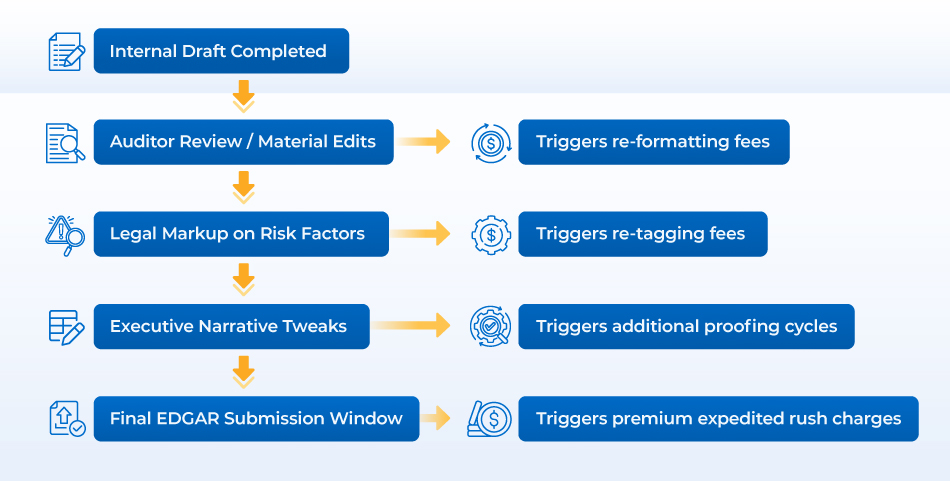
What finance teams experience operationally as “normal last-minute precision” is monetized by legacy vendors as a series of disconnected, high-margin service events. This is where budget predictability completely breaks down.
The SaaS Model Advantage: Fixed Cost, Greater Control
Modern SEC disclosure software operates on a subscription basis. One annual contract covers your full filing volume, 10-K, 10-Qs, DEF 14A, 8-Ks, and any amended submissions.
Automated 10-K iXBRL tagging is embedded in the platform, not billed as a separate service event. Your proxy DEF 14A tagging runs through the same environment as your annual report. No per-page meter running.
The financial logic is straightforward. High-volume filers pay a service-bureau provider in proportion to their filing complexity. The more disclosures you produce, the more the per-page model extracts.
A SaaS platform inverts that relationship. Your heaviest filing periods carry no incremental cost. What that means operationally:
- A restatement that triggers doesn’t cost your team an unbudgeted invoice line.
- Comment letter responses requiring revised filings don’t create cost conversations.
- Additional 8-K filings during an active M&A period don’t move the quarterly vendor spend.
- Specialized reporting areas, like FERC XBRL reporting software workflows, are absorbed into a controlled, repeatable flow rather than isolated, billable production cycles.
Your annual budget number for SEC filing infrastructure is a fixed line, not a range with a ceiling you hope not to hit.
Modern SaaS infrastructure eliminates variable filing fees entirely. Because your internal team retains full execution control within the software, a change made twenty minutes before the SEC window closes costs exactly the same as a change made three weeks prior: zero dollars. You eliminate the financial penalty for precision.
Reevaluate the True Cost of SEC Reporting
The most important question is not what your SEC filing provider costs under ideal conditions.
It is what your reporting process costs when conditions become more complex.
A true TCO analysis should examine:
| Direct software costs. | Professional services spending. | Internal labor requirements. | Filing agility and operational risk. |
When viewed through that lens, many organizations discover that the largest costs are not found in the software subscription itself, but in the operational model supporting it.
See How IRIS CARBON® Changes the Cost Structure
IRIS CARBON® replaces the punitive, per-page service-bureau model with a single disclosure reporting environment.
You get the agility of a SaaS solution to completely own your SEC reporting process, eliminate external dependencies and fast-track filings, while continuing to benefit from the trusted expertise of our regulatory experts.
Cover your 10-K, 10-Q, DEF 14A, and all SEC submissions under one fixed annual contract with XBRL tagging, live validation, and concurrent editing built in.


