
Every public company that has lived through a 10-K crunch knows the call that starts with “we need extra hands” and ends with a six-figure invoice three months later. That’s the quiet math of leaning on an SEC compliance consultant to plug gaps at filing peaks, and in 2026, it’s getting harder to defend to the CFO and the audit committee.
This isn’t an argument that consultants are obsolete. It’s an argument that the default posture (call the consultant when volume spikes, absorb the cost, repeat every quarter) no longer matches what boards expect from a reporting function that’s supposed to be predictable, auditable, and scalable.
Software creates a different cost profile. It can absorb repeatable review, reconciliation, workflow, and validation tasks without adding another layer of people to every filing cycle. AI now pushes that distinction further by taking on portions of the review work that historically required manual consultant involvement.
Evaluating SEC compliance software vs. consultants is no longer a choice between technology and human expertise. It’s a strategic decision about cost predictability, operational bottleneck elimination, and reporting precision.
The Rising Cost of the SEC Compliance Consultant Model
External reporting advisory rates now range from $350 to $750+ per hour for specialized SEC accounting advisory. During peak 10-K filing windows, reliance on external advisory firms creates significant budget overruns that rarely reflect increased strategic value.
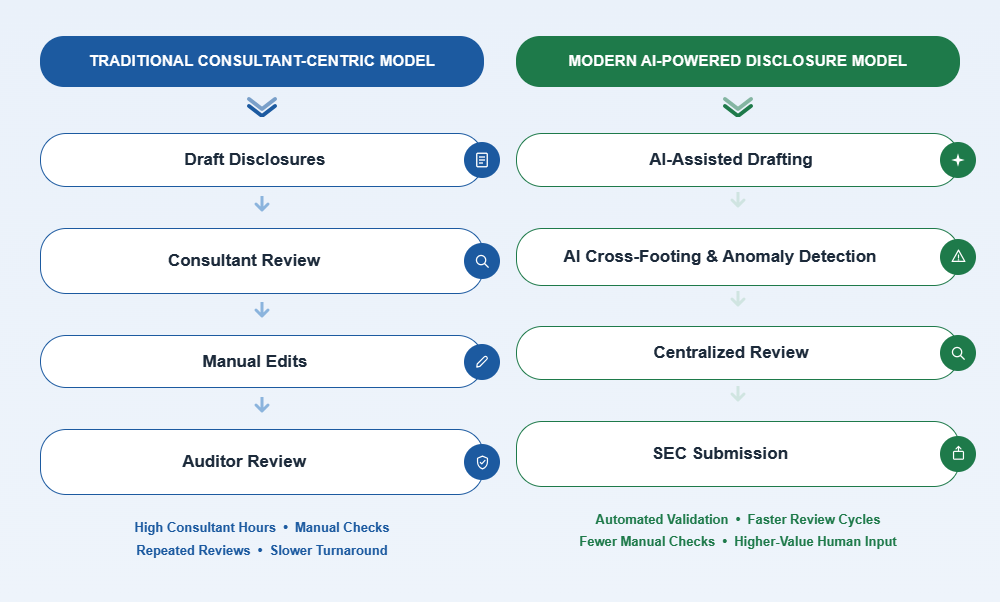
Where Linear Review Breaks Down
The traditional workflow is linear: Draft Footnote → Consultant Redline → Manual Edits → Auditor Review.
In the 72 hours before a deadline, this chain creates real friction. Internal teams end up waiting on external reviewers to check basic items like:
- Roll-forward consistency across financial tables.
- Executive commentary matching reported segment figures
- Assurance and review of narrative sections.
- Taxonomy extension validation against updated SEC rules.
When routine validation depends on external advisory, your filing timeline runs on someone else’s staffing.
The Dependency Trap
Consultants earn their keep on high-stakes work: M&A accounting, IPO readiness, SEC comment letter responses. The friction starts when they’re compensating for gaps in your internal workflow:
- Idle Capacity: Internal teams spend hours re-explaining context or waiting on external responses.
- Knowledge Leakage: Consultants take institutional disclosure knowledge with them when the engagement ends.
- Unpredictable Invoices: Late copy edits trigger unexpected, late-stage billable hour
The Cost Problem Is Not the Consultant. It Is the Dependency.
Experienced consultants solve real problems.
When a company acquires a business, changes accounting policies, enters a new reporting regime, prepares its first filing after an IPO, or faces an unusual disclosure issue, outside expertise can prevent expensive mistakes. No software replaces decades of reporting judgment.
The problem is when consultants compensate for weaknesses in the reporting process itself. In a typical 10-Q cycle, financial statements, footnotes, MD&A, and schedules move through legal, accounting, IR, and auditors before reconciliation and filing on EDGAR. If consultants sit inside several of those steps, the company has built a dependency — one that costs more than the invoice:
- Internal teams re-explain the same information to outside reviewers
- Each change triggers another handoff, stretching review cycles
- Disclosure knowledge stays outside the organization
- Filing peaks become capacity constraints
- Late changes trigger more billable review
- Leaders lose visibility into true reporting cost
The invoice shows only the visible cost. The dependency creates the larger one.
Hidden Friction Points in Consultant-Led Workflows
| Peak Season Billing Premiums: Advisory firms charge top rates for routine formatting, tick-and-tie verification, and standard footnote updates during critical filing deadlines. | Inflexible Turnaround Windows: Consultant review cycles introduce artificial delays. A simple wording change in the MD&A can sit in an external reviewer’s queue for hours, stalling the internal review pipeline. | Knowledge Leakage: Retained consultants take institutional knowledge with them when the project ends. Your internal team pays for the same ramp-up time cycle after cycle. |
When a SEC Compliance Consultant Is Still the Right Choice
There are situations where hiring or retaining a consultant remains the financially responsible decision.
A company preparing for an IPO shouldn’t learn every reporting requirement through trial and error. A company completing a complicated acquisition may need specialists who have handled similar transactions before. A company responding to an SEC comment letter benefits from professionals who understand the Staff’s expectations and have worked comparable issues. A reporting organization facing an unexpected staffing shortage may need immediate external capacity.
None of these are failures of technology. They’re examples of work where experience and judgment carry unusually high value. The goal is to reserve those expensive resources for precisely those situations, not to spread them thin across everything else.
Head-to-Head: Software vs. Consultants
| Criteria | SEC Compliance Software | External Consultants |
| Primary use case | Repeatable filings (10-K, 10-Q, 8-K), iXBRL, continuous monitoring | Complex M&A, IPO readiness, non-routine accounting treatments |
| Cost model | Fixed, predictable annual subscription | Variable, high-cost hourly billable rates |
| Turnaround time | Real-time updates and instant validation | Subject to consultant availability and queue position |
| Data control | In-house, centralized, complete audit trail | Dispersed across external files and third-party systems |
| Scalability | Scales with filing volume, no added headcount | Costs scale linearly, or worse, during peak season |
What Finance Leaders Should Look for in SEC Compliance Software
The SEC reporting software evaluation should begin with workflow, not a long list of software features.
Ask whether the system can reduce the work your team currently performs manually.
Look for:
- Centralized Reporting Workflows – Everyone works from controlled information rather than circulating multiple versions.
- AI-assisted Disclosure Review – In the age of AI, organizations should leverage intelligent tools as primary review consultants rather than relying solely on manual inspection. The system should flag potential inconsistencies and anomalies while leaving accounting judgment with qualified professionals.
- Automated Validation – The system identifies errors before the filing reaches final review, not during it.
- Audit Trails – The organization should be able to establish who changed what, and when, without reconstructing it after the fact.
- Role-based Workflows – Accounting, legal, investor relations, auditors, and management should each get the right access and review responsibilities.
- Generative Drafting & Comparables- Benchmarking disclosure language against peer SEC filings in real time during draft creation, rather than paying an advisory firm to research peer precedent.
- Integrated XBRL and Inline XBRL Capabilities – The filing process shouldn’t require constant movement between disconnected tools.
These capabilities matter because each one removes a manual handoff between the people responsible for getting the filing out the door.
The Financial and Operational Impact
Three effects show up consistently once a disclosure management platform combines the mechanical layer with trusted, consistent AI embedded into the workflow:
- Predictable SaaS pricing replaces runaway billable hours. The board can budget against a known number instead of bracing for a variable invoice that swings with how complicated the quarter got.
- Days come out of the record-to-report cycle. Real-time validation catches errors when they’re cheap to fix, not during a rushed final review when every correction risks introducing a new one.
- Internal teams regain direct control over their own disclosures. That control matters beyond convenience, it’s what lets a Controller answer an audit committee question about the filing without routing it through an outside party first.
A Simple 2026 Decision Framework
For each activity in the SEC reporting process, classify it into one of three categories:
| Category | Primary Resource | Examples |
| Automate | Software / AI | Validation, reconciliation, version control, consistency checks |
| Own | Internal finance team | Accounting conclusions, disclosure decisions, final review |
| Specialize | External consultant | Complex transactions, technical matters, SEC comment responses |
Then ask one final question: are we paying an expert to perform work that a system could perform reliably?
If the answer is yes, that work deserves a technology review. If the answer is no, keep the expert involved.
This framework avoids two expensive mistakes. The first is paying consultants for routine work. The second is trying to automate decisions that require professional judgment.
The Strategic Shift: Buy Expertise, Not Hours
The case for SEC compliance software isn’t that consultants are expensive. Good consultants earn every dollar when their judgment changes the outcome. The problem is spending those dollars on work that doesn’t require that judgment.
Use technology as the operating backbone. Let the internal team retain control over disclosure. Let AI continuously flag potential problems. Bring in specialists when an issue genuinely requires their experience.
That’s a more defensible cost structure, and a reporting organization that can handle a hard quarter without reaching for more consultant hours.
The Decision for 2026 Is Not Software vs. Consultants
The real question: how much of your SEC reporting spend pays for judgment, and how much pays for repetition? The first deserves experienced people. The second deserves scrutiny.
If your team can identify the repetitive work, measure its annual cost, and weigh it against purpose-built software, the decision becomes about operating economics, not technology adoption.
The goal isn’t fewer people in SEC reporting. It’s making sure your highest-expertise people spend their time on the decisions that need it. The companies with the strongest reporting economics won’t necessarily have the fewest consultants. They’ll be the ones using consultants selectively while software absorbs the repetitive work that never should have depended on billable hours.