
The final stretch before a Q3 deadline is notorious for high stress and long hours across corporate reporting, accounting, and legal teams. Yet for many public companies, the biggest threat to a smooth submission isn’t the underlying accounting, it’s relying on an outdated reporting process instead of modern SEC reporting software.
When finance teams depend on disjointed desktop tools like Microsoft Office, offline spreadsheets, and last-minute Inline XBRL tagging, every reporting window becomes a high-wire act. As regulatory authorities enforce stricter compliance checks, minor formatting or tagging oversights can quickly lead to filing rejections, forced amendments, and unwanted regulatory scrutiny.
Having a disclosure management platform is no longer enough. The real differentiator is whether your platform helps teams analyze, draft, validate, and collaborate more effectively, or simply serves as a repository for documents moving through the same manual process.
If your team is gearing up for Q3, evaluate your current workflow against these six clear signs that indicate your disclosure management setup is long overdue for modern SEC reporting software.
1. External Review Still Happens Outside Your Platform
Many disclosure management platforms solve internal version control. The more important question is: how do you manage reviews from people who should not be full users of your platform?
Think about external auditors, legal counsel, consultants, and board advisors working on your Form 10-Q or Form 10-K. They aren’t authoring the document full time, but they absolutely need to weigh in before it goes out the door. They need to review a draft, mark it up, and suggest changes without getting fully onboarded into your disclosure system.
The Warning Sign: If your disclosure management platform forces you to export documents, email PDFs, collect comments manually, and reconcile feedback back into the filing, you’re still running a fragmented review process, you’ve just moved the chaos outside the platform instead of eliminating it.
You know the moment: someone’s redlined a PDF that was already three edits behind, and now you’re manually stitching their comments back into the live draft while the clock keeps running.
The Automated Fix: Modern disclosure management software gives external reviewers a secure, limited-access way to view and comment on the live document, no full license required, no exporting, no version drift. Their feedback lands directly on the current draft, not a stale copy, so nothing gets lost in translation between “what they reviewed” and “what actually got filed.”
Here’s roughly what that failure mode costs teams in practice:
| External Review Failure | Root Cause | Consequence |
| Auditor comments on an outdated PDF | Document exported and emailed for review | Feedback doesn’t match the current draft, comments get discarded |
| Legal’s redlines never make it back in | Manual re-entry of external comments | Disclosure inaccuracy, missed edits |
| No record of who reviewed what, or when | No shared platform access for external parties | Audit trail gaps, compliance exposure |
| Reviewers wait days for an updated draft | No self-serve access to the live document | Review cycle drags, deadline pressure builds |
2. Errors Are Still Being Found at the End of the Process
Discovering a calculation mismatch, a broken cross-reference, or an invalid tag an hour before the EDGAR deadline forces teams into high-stress emergency triage.
The Warning Sign: Validation only happens immediately before submission.
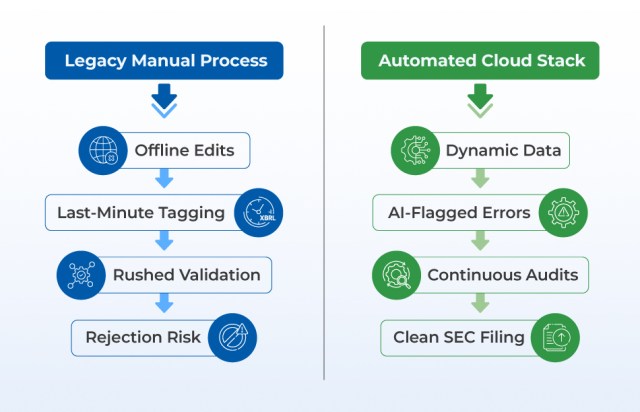
The Automated Fix: Modern SEC reporting software use AI-powered anomaly detection and continuous validation to identify unusual variances, inconsistent disclosures, tagging issues, and potential errors while teams are still drafting content. Catching issues days or weeks earlier dramatically reduces filing risk and eliminates last-minute remediation efforts.
3. Excessive Extension Tags and Evolving Reporting Requirements
Extensible Business Reporting Language (XBRL) allows for custom extension tags, and sometimes you genuinely need one. But if your team defaults to custom tags because hunting through the standard taxonomy takes forever, that’s exactly the pattern SEC automated screeners are built to catch.
The Automated Fix: A disclosure management software with AI-assisted tagging tools solve the actual bottleneck, they check each line item against the current taxonomy automatically, catch inverted signs, flag outdated concepts, and tell you when a standard element exists but nobody bothered to look for it. Less manual mapping, fewer red flags.
4. Bottlenecks Caused by “Black Box” Third-Party Vendors
Outsourcing your iXBRL tagging feels like a reasonable way to offload work, until you need a small text edit fixed and you’re staring down a 4-to-12 hour wait for the vendor to send back an updated proof. That delay is brutal when a deadline is close.
The Automated Fix: In-house, user-friendly reporting tools hand that control back to your own team: instant rendering proofs, edits you can make yourself, and full ownership over both quarterly and annual reporting timelines instead of waiting on someone else’s queue.
5. Your Platform Doesn’t Help Analyze Data
Finance leaders should spend their time on strategic narrative development and qualitative analysis, not fixing broken margins, adjusting column alignments, or reducing manual formatting errors by hand.
A disclosure platform should do more than collect content and manage approvals.
The Warning Sign: Your team still performs all period-over-period analysis manually in spreadsheets before drafting disclosures.
The Automated Fix: AI should help identify significant changes, explain variances, surface trends, and highlight areas that may require management commentary.
If the system isn’t helping teams understand the story behind the numbers, it remains a document repository rather than a true reporting solution.
After all, Finance leaders should spend their time on strategic narrative development and qualitative analysis, not fixing broken margins, adjusting column alignments, or reducing manual formatting errors by hand.
6. Your Team Is Still Drafting Most Narrative Content Manually
Preparation of MD&A, earnings commentary, footnote updates, and other narrative disclosures often consumes significant time each quarter. For a Form 10-Q or Form 10-K, that means someone is starting from scratch on language that barely changes period over period, just to get the draft moving.
The Warning Sign: Teams start every reporting cycle with a blank page and manually rewrite recurring disclosures. The same liquidity discussion, the same risk factor language, the same footnote structure, retyped or copy-pasted forward each quarter and then hand-edited to match the current numbers.
You know the drill: someone pulls up last quarter’s 10-Q, opens a new document next to it, and starts manually updating figures and phrasing line by line, hoping nothing gets missed in the copy-paste.
The Automated Fix: Modern AI-enabled SEC reporting solutions should assist in generating first drafts based on current-period financials, prior filings, and approved disclosure language. Instead of starting blank, teams start with a draft that already reflects this quarter’s numbers and the organization’s established tone and terminology, then focus their time on reviewing and refining rather than writing from zero.
The opportunity here isn’t just automating formatting and tagging. It’s reducing the effort required to produce high-quality disclosures while maintaining consistency and control across every Form 10-Q and Form 10-K your team files.
Upgrade Your Stack Before the Next Deadline
Quarterly filing deadlines don’t have to mean late nights, version confusion, and tagging anxiety.
SEC filings don’t have to be a late-night scramble dominated by version confusion and tagging anxiety. By upgrading to modern SEC reporting software with real-time data linking, cloud collaboration, and AI-flagged validation, you can turn a stressful quarterly filing into accurate disclosures, fewer surprises, and a team that isn’t burnt out by the time the filing actually goes in.


