
You don’t find out whether a disclosure management system actually works during the vendor demo. You find out three days before a 10-Q is due, when four people need to be in the same document at once, and a late tag change has quietly broken the balance sheet.
For a controller or chief accounting officer, choosing a reporting platform isn’t a procurement decision. It’s a risk decision. Get it wrong and you’re looking at version-control chaos, a strained relationship with your auditors, and a real chance of a delayed filing.
The only way to evaluate these systems properly is to ignore the sales deck and ask how the platform behaves under the kind of pressure that shows up every single quarter. Below are the five things that matter most, and what each one actually costs you when it’s missing.
Here are the five non-negotiable capabilities your next SEC reporting platform must deliver.
1. True Multi-User Collaborative Editing with Component-Level Locking
The final 72 hours before an SEC filing are chaotic. The tax team updates the effective tax rate table, corporate legal amends the commitments and contingencies note, and the external auditors demand a last-minute change to the management discussion and analysis (MD&A) section.
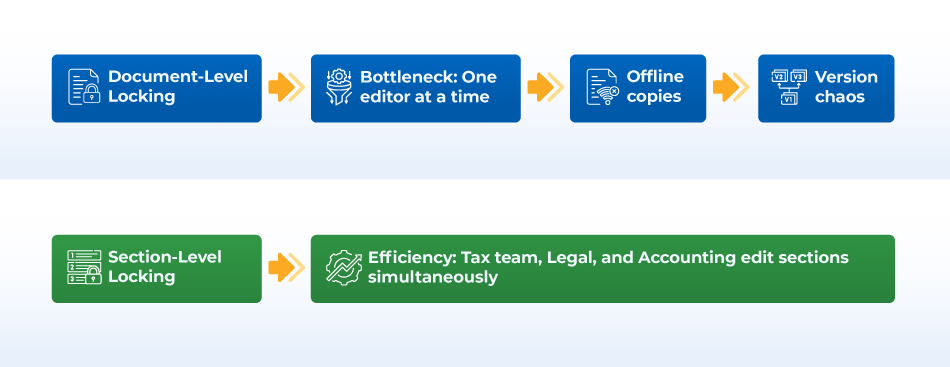
Traditional reporting software often handles this with document-level locking. If one user opens the financial statements, everyone else gets locked out or forced into read-only copies. This creates an artificial bottleneck that extends your team’s working hours and introduces massive version-control risk when users resort to tracking changes offline in separate files.
The Operational Reality
Modern disclosure platforms offer section-level or component-level locking. This allows the financial planning and analysis (FP&A) team to update narrative sections while the technical accounting group finalizes the cash flow statement in the same document at the same time.
Why this matters:
- Reduces Overtime Costs: It removes the sequential bottleneck that turns a four-hour close task into a fourteen-hour one, because nobody is sitting around waiting for their turn in the document.
- Mitigate Version Risk: It keeps every edit inside one audit trail, instead of scattered across copies, which is exactly how an outdated footnote ends up filed by mistake.
2. Real-Time Validation and AI-Powered XBRL Tagging
If you’re still running validation checks and XBRL tagging at the very end of the cycle, you’re finding your worst errors at the worst possible time. Send tagging out to a third party and you also lose visibility into how those tags interact with the data sitting underneath them.
A platform built for this should validate continuously. The moment someone changes a number, the system checks it against related disclosures, cross-references, and the taxonomy itself. Not at the end. Right then.
Here’s why the timing matters so much. If an error in a segment reporting disclosure only surfaces during the final validation pass, you can’t just patch it. You have to re-run the entire tagging sequence. That can cost you hours, sometimes days, and it puts a non-timely filing notice on the table. That notice doesn’t stay quiet. It shows up with investors, and in some cases it can trip a covenant in your debt agreements.
| Validation Type | Legacy Approach | Modern Requirement | Operational Impact |
| XBRL Integration | Post-draft outsourcing | Real-time, AI-powered tagging | Eliminates 24-48 hour turnaround bottlenecks |
| Cross-Reference Checking | Manual tie-out binder | Automated calculations | Catches mathematical discrepancies instantly |
| Error Detection | Batch processing at end | On-the-fly alerts | Prevents compounding errors across footnotes |
3. Continuous SOC 1 Type II and SOC 2 Type II Compliance
Your reporting platform is part of your internal control environment whether you treat it that way or not. If it doesn’t carry strong, current security attestations, you’ve built a blind spot directly into your SOX compliance.
It’s not enough for a vendor to tell you their cloud host is secure. AWS or Azure being SOC 2 compliant says nothing about how the vendor’s own application handles your data, your development process, or your user access. You need the vendor’s own SOC 1 Type II and SOC 2 Type II reports, covering their actual platform.
This isn’t a box-checking exercise either. Your external auditors will ask for these reports during the annual audit. If they come back with material exceptions, or without enough detail on complementary user entity controls, your audit team has to start testing the vendor’s environment directly. That’s substantive testing hours. Those hours land on your audit fee.
A few things worth confirming before you sign anything:
- Role-Based Access Control: Can you restrict investor relations to read-only while giving your SEC reporting manager full edit rights?
- Detailed Audit Trails: Does the system log the exact timestamp, the user, and the old and new value for every change, down to individual edits, not just document-level saves?
4. Single-Source Data Linking Across Documents and Presentations
The same net income figure, the same capex number, the same segment revenue line doesn’t live in just the 10-K. It’s in the earnings release, the board deck, the investor presentation, and often a statutory filing somewhere too.
Copying and pasting that number across five files is asking for a mismatch. Someone updates the 10-K and forgets the slide deck. Someone fixes the slide deck and the press release still has the old figure. None of this is a competence problem. It’s a process problem, and it’s exactly what active data linking is built to solve.
With a single source-of-truth dataset feeding every document, a change to one accrued liability account flows automatically into the 10-K, the 8-K earnings release, and the investor deck. Nobody has to remember to update four files by hand.
This matters most when the audit committee asks for a last-minute adjustment two hours before a board meeting. If your data isn’t linked, that adjustment becomes a manual tie-out exercise across every document that referenced the old number. If it is linked, it’s one update.
5. Cost Predictability and Transparent Pricing Structures
The upfront subscription price on a reporting platform rarely tells you what you’ll actually pay. A lot of vendors get you in the door with a modest SaaS fee, then charge heavily for the things you need most during the two weeks a year when your bandwidth is lowest.
Watch for these specifically:
- Per-page Charges: Some platforms still bill like a typesetting shop, based on document length or complexity.
- XBRL Surcharges: Extra fees for custom extensions or for keeping up with taxonomy updates.
- Support Tiers: Paying more to get a real person on the phone at 2 AM the night before filing, instead of a ticket queue.
None of these show up clearly in a sales quote. They show up on the invoice after your first busy season with the platform, and by then you’ve already signed a multi-year contract.
Push for flat, all-inclusive pricing that doesn’t move based on document length, the number of validation runs you trigger, or how much support your team needs during filing week. If a vendor can’t commit to that in writing, that tells you something about how filing week will actually go.
A Strategic Framework for Making the Decision
Skip the long feature comparison. Bring this list into the room, and ask the vendor to prove each one live, using your actual prior-year 10-K, not a sample file they’ve already optimized for the demo.
- Concurrent editing: Can three people edit different parts/sections of the same note at the same time without locking each other out?
- Real-time validation: Does the system flag an obsolete or broken XBRL tag the moment the data changes, not after you click “validate”?
- Audit trail depth: Can it pull a complete change history for one specific cell over a 30-day window, on demand?
- Linked documents: If you change a number in the financial statements, does it update instantly in both the 10-K draft and the investor deck?
- Cost certainty: Is the cost of an out-of-period taxonomy update already covered in the base subscription, or is that a separate invoice waiting to happen?
A platform that handles all five of those live, in front of your own team, has told you something real about how it performs under pressure. One that needs more time, a different setup, or “the right person on the call” to answer any of them has told you something just as real, just not what they were hoping you’d hear.
The right system doesn’t just get the filing done. It changes how your team spends filing week, every quarter, for years. That’s worth more scrutiny than most evaluations give it.


