
There is a conversation happening in boardrooms in New York, Frankfurt, and London that has not yet become the default conversation in Mumbai, Bengaluru, or Delhi.
It is not about whether AI belongs in the finance function. That question has been answered. Eighty-seven percent of North American CFOs now expect AI to be extremely or very important to their finance operations in 2026. Globally, AI adoption in finance has reached 72% — more than double the figure from the previous year. The debate in those boardrooms is no longer about adoption. It is about sequencing — which workflows to transform first, how to retrain teams, and how to govern AI-generated outputs.
India has not yet arrived at that conversation. And the reasons are structural, not personal.

What the West Built First
What most conversations about the AI gap miss is that AI was never the starting point. Before US and EU finance teams could automate anything, they had to connect everything.
Over the past decade, large organisations in the US and Europe systematically replaced their fragmented reporting infrastructure with purpose-built Disclosure Management platforms. Workiva — the market leader in this space — today serves approximately 80% of the Fortune 1000.
Companies like Blackstone, Air France, Microsoft, Nestlé, Toyota and Eni have been running their annual reports, regulatory filings, and ESG disclosures through connected disclosure management systems — not Excel, not email, not shared drives — for years. European companies adopted these platforms specifically to comply with ESMA’s European Single Electronic Format requirements, with GLEIF’s Workiva-built annual report cited by ESMA itself as a model for ESEF compliance.
- What these platforms gave those finance functions was not just speed. It was structural control:
A single source of data feeding every document simultaneously. - Collaborative authoring and review workflows that replaced email chains.
- Version control that made the question, “Which file is final?”, permanently obsolete.
- A governance trail that could answer any auditor’s query within minutes.
The disclosure process became a system. Not a scramble.
That infrastructure is what made AI adoption possible. Clean, connected, traceable data is the foundation on which every useful AI application in finance is built.
The US and EU did not adopt AI and then become organised. They organised first. The AI followed.
What “Moved On” Actually Looks Like
In the US and EU, the finance function has been quietly rebuilding itself around AI for the better part of three years — but only because the infrastructure underneath it was already solid.
AI adoption in FP&A specifically surged from 6% in 2024 to a 41% increase in usage in 2025. Among CFOs who have scaled AI into full production, 41% rate outcomes as strongly positive — compared with 25% among those still in pilot mode. The return is not in the AI itself. It is in the scaling. And scaling requires infrastructure.
Forty-five percent of finance teams globally are still in limited pilot mode, and only 17% are actively using AI in their core workflows.
Even in advanced markets, most organisations are early. But the ones that are not early built their advantage on something India’s finance functions are still in the process of establishing: a reporting process that was designed to be digital from the ground up

Why India Is Still Deciding and Why That Is Not the CFO’s Fault
68% of CFOs globally say they have been slow to adopt AI because they do not know where to start — and that is in markets with mature vendor ecosystems, AI-literate boards, and a decade of cloud migration behind them.
In India, the starting conditions are different. Not worse — different. The regulatory landscape is moving fast but unevenly. BRSR mandates, XBRL filings, phased assurance requirements — the compliance surface area is expanding every year, but the tooling to manage it has not kept pace.
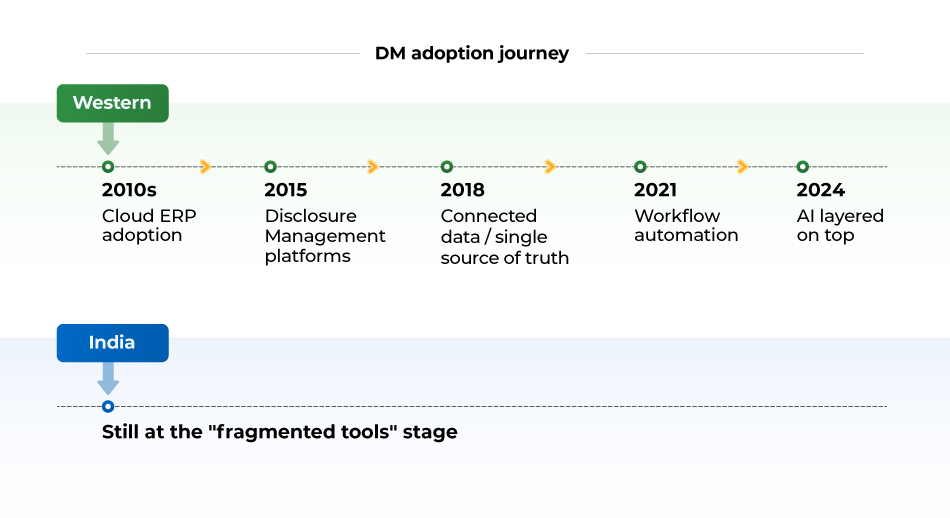
Most listed Indian companies are still managing their disclosure process across Excel, Word, email, and institutional memory. The data exists. It is not connected. And unconnected data is not a foundation on which AI can build anything useful.
There is also a sequencing problem that is often misunderstood. Western finance functions adopted cloud infrastructure first, then data standardisation, then disclosure management, then automation, then AI.
Indian organisations are being asked to compress that journey — while simultaneously managing an expanding regulatory calendar and a reporting process that was never designed to be digital. The CFO is not behind. The infrastructure is.
Why the Window Matters
54% of North American CFOs say integrating AI agents in their finance departments will be a transformation priority in 2026. These are not pilots.
They are production deployments, built on infrastructure that took years to establish.
The gap between early movers and late adopters in this cycle will be wider than in previous technology transitions — because AI compounds on itself. Better data produces better models. Better models justify further investment in data.
For Indian CFOs, the regulatory calendar is actually an opportunity disguised as pressure. BRSR assurance requirements expanding to the top 1,000 companies by FY2026-27.
Especially with the XBRL mandates already in force and anticipated enforcement of iXBRL. Every one of these creates a forcing function to clean, connect, and trace data — which is precisely the infrastructure that AI requires.
The organisations that treat compliance as the occasion to build that infrastructure will find themselves, in two or three years, with the foundation for genuine AI-enabled finance.

What Closing the Gap Requires
The starting point is not AI. It is the layer beneath it.
The US and EU companies that have moved furthest did not begin with automation. They began with a disclosure process where:
- Every number had a home.
- Every document drew from the same source.
- Every workflow was tracked.
- Every approval left a trail.
Disclosure Management was the infrastructure that made everything else possible. It is still the infrastructure that makes everything else possible.
In India, that infrastructure is largely absent — not because the capability does not exist, but because the market for it has been slow to form. That is changing.
Adding Disclosure Management to your existing Tech Stack is critical today and this is where CFOs are heading into.
For example, here is what Eni, Italian energy giant, has to say about adding DM to it’s tech stack:

IRIS CARBON® is India’s only purpose-built Disclosure Management platform — built specifically for the regulatory, linguistic, and governance requirements of Indian listed companies.
The same infrastructure that Fortune 1000 companies in the US and EU built over a decade, Indian organisations can now access in a single deployment:
- Connected data.
- Collaborative authoring and review.
- Built-in regulatory validation.
- A governance trail that holds up under scrutiny.
The window is open. The infrastructure exists. The decision is the only thing remaining.