
There’s a quiet contradiction living inside most finance teams today.
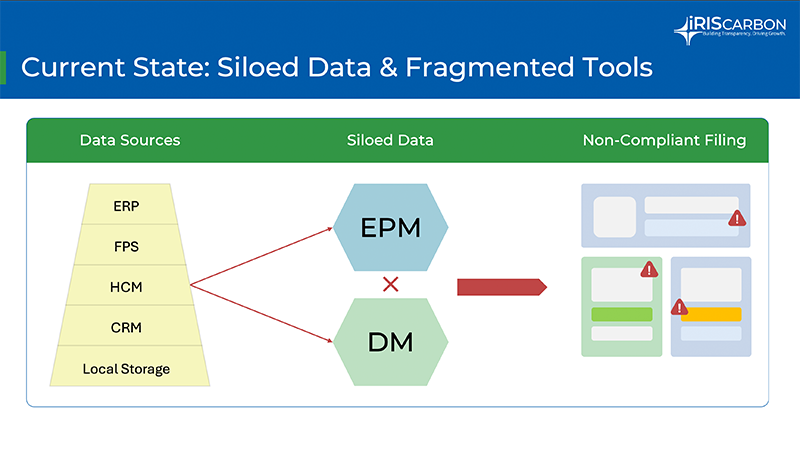
They are expected to deliver accurate budgets, reliable forecasts, airtight compliance reports, and timely disclosures all with the confidence of a team working from a single version of the truth. But behind the scenes, many of them are doing something far messier: toggling between two separate environments, manually exporting data from one system and pasting it into another, and hoping nothing breaks along the way.
“Finance teams extract data from various systems, copy them into Excel, and from Excel copy them into Word and the whole relationship between the source data and the end report is lost.”
— Robert Kuppeveld, Senior EPM Consultant, PlanPulse
On one side is their Enterprise Performance Management (EPM) system where budgeting, forecasting, and consolidation happen. On the other is their Disclosure Management (DM) platform where financial reports are drafted, narratives are written, and compliance requirements are managed.
Same team. Two environments. Two data sets. One slow-building crisis.
| Environment 1
EPM
|
Environment 2
Disclosure Management
|
This isn’t a technology problem in isolation. It’s a workflow problem with real financial and reputational consequences. When EPM and DM don’t communicate, the downstream effects are predictable and painful. Here are the three challenges we see play out time and again.
The Challenges: 3 Ways the Disconnect Is Costing Your Finance Team
Challenge 1: The Collaborative Bottleneck
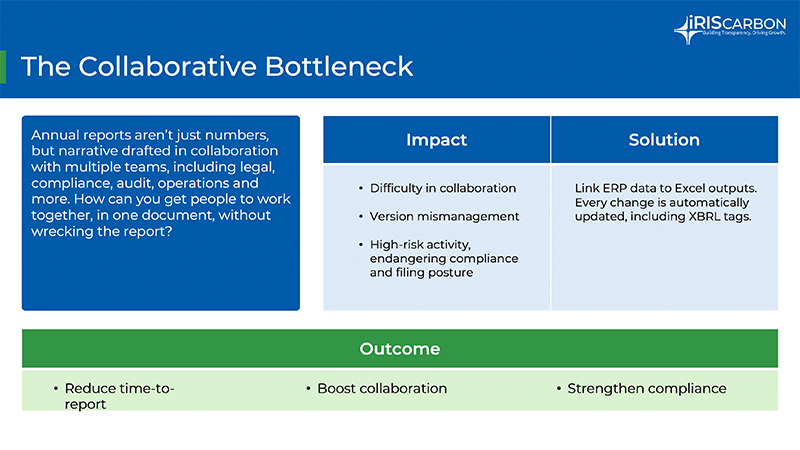
Annual reports are not just numbers. They are narratives drafted in collaboration with legal, compliance, audit, investor relations, sustainability teams, and more. Getting all of those people to work together in one document, without wrecking the report is one of the hardest operational challenges finance teams face today.
Here is how it typically plays out: various versions of Excel sheets and Word documents are sent back and forth via email. At a certain point, nobody knows which version is current. Legal has v7. Finance is on v9. The CFO’s office is reviewing a printout from v5. The result is version chaos, missed updates, and a filing posture that is quietly deteriorating.
| Real scenario:
A listed European manufacturer’s finance team is preparing their annual report. The EPM team finalizes consolidated figures on a Friday afternoon. The disclosure team, working simultaneously in a separate platform, is drafting MD&A based on what they believe is the latest data but they’re working from a snapshot taken two days earlier. A late consolidation adjustment never made it across. The report is submitted. The figures are off by a material amount. The correction comes later, publicly. |

| The Conflict | EPM updates don’t automatically flow into the DM draft; teams are manually bridging the gap every time. |
| The Risk | One missed cell creates a discrepancy between financial statements and narrative disclosures. |
| The Impact | When MD&A numbers contradict audited tables, auditor trust evaporates and rework cycles explode. |
“Every manual export and paste is a point of failure. The reconciliation burden isn’t just an efficiency problem but a trust problem, with auditors, with leadership, and with the market.”
— Anuradha RK, Business Head, IRIS CARBON
Challenge 2: The Late Adjustment Nightmare
You have created the annual report. The team is ready. Then the CFO walks in and says an auditor flagged a reclassification, a pension provision needs to be updated. Not just in the P&L. In the notes. In the MD&A. In the comparatives. Everywhere.
This is the nightmare scenario that Robert described during the webinar and it is far more common than most finance leaders would like to admit. Two days before the filing deadline, a late adjustment arrives. Maybe from a subsidiary. Maybe from the auditor. Maybe from a regulatory clarification. You thought you were ready. Now you have cascading updates to make across disconnected documents.

| Real scenario:
A professional services firm closes its books, exports actuals from EPM to Excel, and hands them to the disclosure team, who reformat the data and begin emailing Word documents across legal, IR, and the CFO’s office for review. Weeks pass. By the time sign-off arrives, the numbers are stale, and the team has no bandwidth left for analysis. Then a final audit adjustment comes in. The cycle starts again. |
The problem is not just the update itself. It is the confidence problem that follows. After making that one last change at 10:00 AM before a 3:00 PM submission deadline, how do you know it has reflected everywhere? In every table, every note, every narrative reference, every language version? Without connected systems, you do not know. Someone is manually checking, endlessly, because the stakes are too high not to.
| The Conflict | Disclosure teams wait on EPM outputs before drafting can begin it makes it a sequential and not a parallel workflow. |
| The Risk | Deadline pressure forces sign-off on reports that have not been fully validated. |
| The Impact | Leadership gets numbers when they need insights, and the finance team is too exhausted to provide either. |
“Finance is always closing the last period instead of informing the next one. That is the real cost of disconnected systems, and it does not show up in any single budget line.”
— Robert Kuppeveld, Senior EPM Consultant, PlanPulse
Challenge 3: The XBRL Black Box
More and more companies are now required to file using XBRL which is the machine-readable digital reporting format mandated by regulators across Europe and beyond. Countries like the Netherlands, Italy, and Finland have already adopted it for listed and private companies alike, with broader requirements coming into force under IFRS 18 and ESG disclosure mandates.
The problem? Finance teams finish their report and then outsource XBRL tagging to a third-party consultant. The document leaves their hands. They have no visibility into whether the tags are correct. No way to validate. No audit trail. And then as Anuradha described in the webinar, they find out the numbers don’t match.

| Real scenario:
A listed retailer submits its annual report to an external XBRL vendor at version 8.5. The finance team keeps making changes internally and reaches version 10.1 by filing day. The vendor is still working on 8.5. The revenue figure tagged in the XBRL file is materially different from what appears in the final published report. The inconsistency surfaces only after filing in a question from investors. |
This is not just a compliance problem. It is a visibility and control problem. Finance teams lack the regulatory knowledge to validate XBRL tagging themselves, and the process of coordinating with external vendors under deadline pressure creates exactly the kind of version drift and data inconsistency that erodes stakeholder trust.

| The Conflict | Sensitive financial data moves outside the organisation with no visibility or control over whether tags are correctly applied. |
| The Risk | Last-minute number changes in the report are not reflected in the XBRL filing creating material inconsistencies. |
| The Impact | Regulatory exposure, prolonged turnaround, and the reputational cost of publicly correcting a filed document. |
The Fix: One Source of Truth Across EPM and Disclosure Management
All three challenges share one root cause: the finance team is managing two data environments instead of one. Integration closes that gap permanently.
The solution is not to work harder within the current setup. It is to eliminate the gap between EPM and Disclosure Management by connecting them through an integrated platform, one where data flows seamlessly from ERP and consolidation systems all the way through to the final disclosure, including XBRL filing, without a single manual export.
When EPM and DM share a single data foundation:
- Actuals from consolidation flow directly into disclosure templates – no export, no paste, no version drift.
- A single number change updates everywhere it appears: tables, narratives, notes, MD&A, language variants, and XBRL tags simultaneously.
- Audit trails span the full journey from plan to disclosure, with granular visibility into who changed what and when.
- All stakeholders including finance, legal, audit, compliance, work in one centralized document with role-based access controls.
- Finance teams spend less time moving data and more time analysing it.
During the webinar demo, Anuradha walked through exactly this scenario showing how a single number change in the EPM system triggered real-time notifications across every affected section of the annual report, including the MD&A narrative, consolidated P&L, notes to accounts, and the XBRL file. The change flowed through in seconds. No manual checking required.
“One team. One workflow. One source of truth. Finance cannot afford to operate in any other way.”
— Anuradha RK, Business Head, IRIS CARBON
Want to See How Integration Works in Practice?
weeks
Beyond efficiency gains, integration delivers something harder to quantify but equally important: confidence. When you know that the last change you made at 10:00 AM on filing day has automatically flowed through to every table, note, narrative, and XBRL tag — you can submit with certainty. That confidence has real value in front of auditors, regulators, and investors.
Missed the Session? Here Is How to Go Deeper
Everything covered in this blog was unpacked live by our speakers. Learn more about what an integrated EPM and Disclosure Management environment actually looks like in practice.
Get your copy of “The Connected Finance Frontier: Bridging the Gap Between EPM and Disclosure Management.“