
The most dangerous hours of any quarterly close don’t happen inside the ledger. They occur in the fragile bridge between your trial balance and your 10-Q or 10-K draft.
During every close cycle, corporate accounting teams face an overlapping timeline where financial statement preparation, auditor review, and SEC reporting deadlines collide. When accounting teams manually bridge ERP data into disclosure management tools, every last-minute adjusting journal entry carries a hidden operational cost: version control failures, broken XBRL tag links, high-paid talent performing manual copy-paste validation, and an elevated risk of late filings or restatements.
Closing the gap between internal accounting and external filing requires treating SEC reporting as an automated extension of the close process rather than a disconnected downstream task.
Where Finance Team Bandwidth Actually Breaks Down
Bandwidth strain during close-and-filing overlap doesn’t show up evenly. It concentrates on three specific failure points.
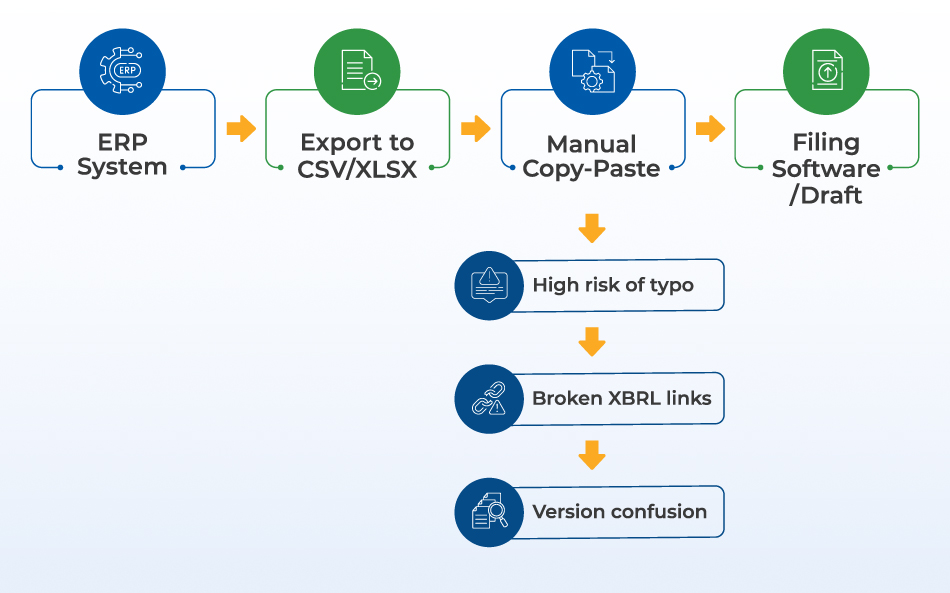
1. The Manual Handoff Between GL and Disclosure Documents
Most organizations still move data from the general ledger and consolidation system into the filing document through exported trial balances, pivot tables, and copy-paste into Word or a disclosure management tool. Every manual touch is a place where:
- A number gets transposed.
- A prior-period comparative doesn’t get updated when a reclass happens late.
- A schedule ties to the wrong version of the TB because someone pulled it before the last adjusting entry posted.
None of this happens because the staff is careless. It happens because there’s no single source of truth connecting the ledger to the document. The ledger updates; the document doesn’t know it updated until someone manually refreshes it.
2. XBRL Tagging as an End-of-Cycle Bottleneck
Ask any reporting manager when XBRL tagging happens, and the honest answer at most companies is: “after the narrative is basically final.”
Tagging (including Inline XBRL rendering checks) then competes for the same 48–72 hours as final review, audit sign-off, and disclosure committee approval. Treated as a downstream, tool-driven task instead of something updated continuously as the document is built, tagging becomes the thing that gets rushed. Rushed tagging is where XBRL validation errors and inconsistent element usage across periods creep in.
3. Review Cycles That Restart from Scratch
When source data changes late, most teams can’t isolate the downstream impact. The whole document goes through another full review pass because nobody can say with confidence which sections were actually touched by the change. That’s not thoroughness. That’s a symptom of missing traceability between a number and everywhere it appears in the filing.
Comparing Reporting Workflows: Disconnected vs. IRIS CARBON
| Workflow Dimension | Disconnected / Manual Bridge | Automated Data Flow with IRIS CARBON |
| Data Ingestion | CSV exports, email attachments, manual copy-paste | Direct Excel linking and ERP integration into a secure, cloud-based platform |
| Adjusting Entries | Manual updates across 10+ footnotes and tables | Single-source update that auto-populates all linked primary statements and footnote disclosures |
| XBRL Integration | Tags assigned and re-checked manually post-narrative in a 48-hour crunch | Concurrent iXBRL tagging built into document drafting, backed by expert review |
| Audit Trail | Fragmented across local hard drives and chat threads | Line-item version history, granular attribution, and complete audit-ready tracking |
| Team Overtime | Extreme late-stage surges, weekend work for senior staff | Predictable, collaborative review cadence across internal teams and external auditors |
| Version Management | Different team members work off different copies of the file. No one is fully sure which one is the latest. | Single, live cloud document serving as the single source of truth with real-time updates. |
| AI Capabilities | None; drafting, summarizing changes, error-checking, and regulatory tracking rely entirely on manual effort. | Built-in AI assistance for drafting disclosures, summarizing period-over-period changes, detecting anomalies, and monitoring regulatory updates. |
Those hours aren’t hypothetical. They show up as weekend work, as a reporting manager missing a kid’s game because “the filing has to go out Monday,” and eventually as turnover on teams that are already hard to staff.
The Real Question: Where Does the Data Actually Break Continuity?
Ask most CAOs where their filing risk lives, and they’ll point to judgment areas like revenue recognition, impairment testing, contingencies. Those matter, but they’re not where the operational strain concentrates. The strain concentrates at every point where data leaves one system and gets manually reintroduced into another.
Tracing One Number Through the Filing Process
Trace a single material number, say, total revenue by segment, from the sub-ledger to the 10-Q, and count the touches:
- Sub-ledger closes and rolls into the consolidation system.
- Consolidation produces a trial balance export.
- Someone builds a supporting schedule in Excel.
- That schedule gets copied (or re-typed) into the disclosure management tool or Word template.
- XBRL tags get applied to that same number, separately.
- Reviewers check the number against the schedule, the schedule against the TB, and the TB against the sub-ledger, three reconciliations for one data point.
Every one of those handoffs is a place where version control fails silently. Nobody flags an error at step 4 because nothing tells them the number changed at step 1. Closing the gap between finance teams and filing deadlines isn’t really about adding people to review harder, it’s about collapsing the number of manual handoffs a data point survives between the ledger and the filed document.
What Automated Data Flow Actually Changes
Automated data flow from accounting systems into filings doesn’t remove human judgement, disclosure decisions, materiality calls, and narrative language still require an experienced preparer and reviewer. It changes the mechanical layer underneath those decisions:
- A number updates once, at the source – every place it appears in the filing (financial statements, footnote schedule, XBRL tag, MD&A table) reflects that update without a second manual entry.
- Reviewers see what changed, not just that something changed – turning a full re-review into a targeted one.
- XBRL tagging happens as the document is built, not as a separate final-stage task competing for the same 48 hours as narrative review.
- Preliminary and final numbers stop being two separate populations, there’s one population, and its status (draft, reviewed, final) is tracked, not its value re-entered.
That’s the difference between a team spending its last week verifying that copies match originals, and a team spending its last week actually reviewing disclosure judgment, the only part of the process that genuinely requires their expertise.
Architectural Strategy: Automating the Flow from ERP to EDGAR
Eliminating the crunch requires a direct pipeline between the system of record (the ERP or CPM platform) and the reporting system (the SEC disclosure platform).
- Direct database and API connections. Linking general ledger balances directly to the SEC reporting engine via secure APIs or database integrations means financial statement line items refresh in real time when a trial balance changes.
- Centralized data linking across footnotes. A single data point, such as stock-based compensation expense, can appear in the cash flow statement, the income statement, and multiple footnotes. Automated data links connect all these instances together. Update the number once, and it updates everywhere else automatically.
Continuous audit trail. Every balance update is logged automatically. The system tracks who made the change, when it happened, and which part of the general ledger it came from. This means auditors can see everything clearly, right away. No one has to ask “which version is this?” during final sign-off anymore.
A Decision Framework for Closing the Gap
Don’t start by asking whether to buy a disclosure management tool or add headcount. Start by mapping the path.
- Pick one material number, revenue, EPS, a major footnote balance.
- Trace every system it touches between the general ledger and the filed document.
- Count the manual re-entries it survives along the way.
- Flag each touch as a continuity break, a place where a reviewer has to verify rather than trust, and where a late change forces a re-do instead of a targeted update.
- Rank the breaks by frequency of late changes hitting that stage, the highest-frequency break is where automation pays back fastest.
The finance teams that close the gap between close and filing aren’t the ones working more hours in the last week of the quarter. They’re the ones who’ve reduced the number of times a number has to be manually reintroduced into a new system before it reaches the filing because every one of those reintroductions is where bandwidth actually goes, and it’s the one part of the process that adds no analytical value at all.


