
Every SEC reporting team knows the feeling. It’s the night before the deadline, the disclosures are locked, the financial statements are signed off, and then EDGAR kicks the filing back with a tagging error nobody caught.
That moment is rarely about the numbers being wrong. It’s almost always about how those numbers were tagged. Inline XBRL (iXBRL) tagging errors are, by a wide margin, the most common reason filings get delayed at the last possible minute and the reason is structural, not accidental. Most teams don’t validate tagging until it’s far too late in the filing cycle to fix it calmly.
Why iXBRL Errors Derail Filings at the Worst Possible Time
The shift from traditional, standalone XBRL instance documents to iXBRL (where machine-readable tags are embedded directly into human-readable HTML) was designed to streamline financial reporting and enhance transparency. By unifying the visual report and the underlying data layer, investors and regulators view the exact same document.
However, iXBRL brings the human-readable report and its machine-readable data layer together in the same filing. That makes accurate synchronization between the two layers critical, especially as financial reports undergo changes late in the reporting cycle. Financial reports are finalized under extreme deadline pressure, usually during the final 24 to 48 hours of a reporting cycle.
Narrative edits, late audit adjustments, and last-minute footnote modifications occur right up to the submission window. When late text or numerical adjustments are entered into the presentation layer without synchronized updates to the underlying structured tags, the machine-readable layer breaks.
When a filing package is transmitted to EDGAR, automated validation scripts parse the document before accepting it. If the system encounters structural tagging errors, broken calculation arcs, or invalid taxonomy extensions, EDGAR rejects or suspends the filing outright. Fixing these technical glitches under a ticking clock at 11:00 PM requires untangling complex taxonomy relationships, a process that regularly causes teams to miss their mandatory SEC filing cut-offs.
The Compounding Effect of Late Discovery
A tagging error caught during first-draft tagging costs you a correction. The same error caught during final EDGAR validation costs you:
- A re-render and re-review of the affected exhibit.
- A second look from whoever owns disclosure controls, because a material tagging error is technically a control finding.
- Possible re-engagement of external counsel or the auditor if the underlying number was also touched.
- Compressed time for the print vendor or filing agent, who now has a change request inside their own crunch window.
None of these costs show up on an invoice as “XBRL rework.” They show up as overtime, as auditor irritation, as a disclosure controls memo nobody wanted to write, and in the worst cases, as a filing that goes out technically late or requires a subsequent amendment.
The 5 Most Common iXBRL Tagging Errors
XBRL US and the SEC’s own review data point to a small handful of recurring problems. If your team fixes these five categories, you eliminate the bulk of your suspension risk.
1. Invalid Axis-member Combinations
This is the single biggest source of trouble, and it’s easy to see why. A dimensional axis defines a category, a domain member is a specific value within it, and the two have to make logical sense together under US-GAAP taxonomy rules.
The Classic Mistake: filers place ParentMember under LegalEntityAxis in a stockholders’ equity table, when ParentMember actually belongs under EquityComponentsAxis, which exists specifically to separate parent equity from non-controlling interests.
Visually, the table looks perfectly normal. A human reviewing the printed page sees nothing wrong. But the machine-readable layer just paired two incompatible accounting concepts, and the validation engine catches it immediately.
2. Sign Convention Errors
Over a tenth of all XBRL errors trace back to sign mistakes, and this one deserves a closer look because it’s counterintuitive to anyone thinking in terms of financial statement presentation rather than taxonomy logic.
On the page, expenses and cash outflows show up in parentheses. That’s a presentation convention. But the underlying taxonomy element already has a defined balance type, debit or credit, baked into its definition.
If someone manually tags a naturally positive debit concept with an explicit negative sign because “that’s how it looks on the page,” the calculation engine inverts the math.
Wrong: us-gaap:OperatingExpenses tagged as -45000000 because it displays as (45,000,000) on the statement.
Correct: us-gaap:OperatingExpenses tagged as 45000000, with the parenthetical presentation handled through formatting, not through an inverted fact value.
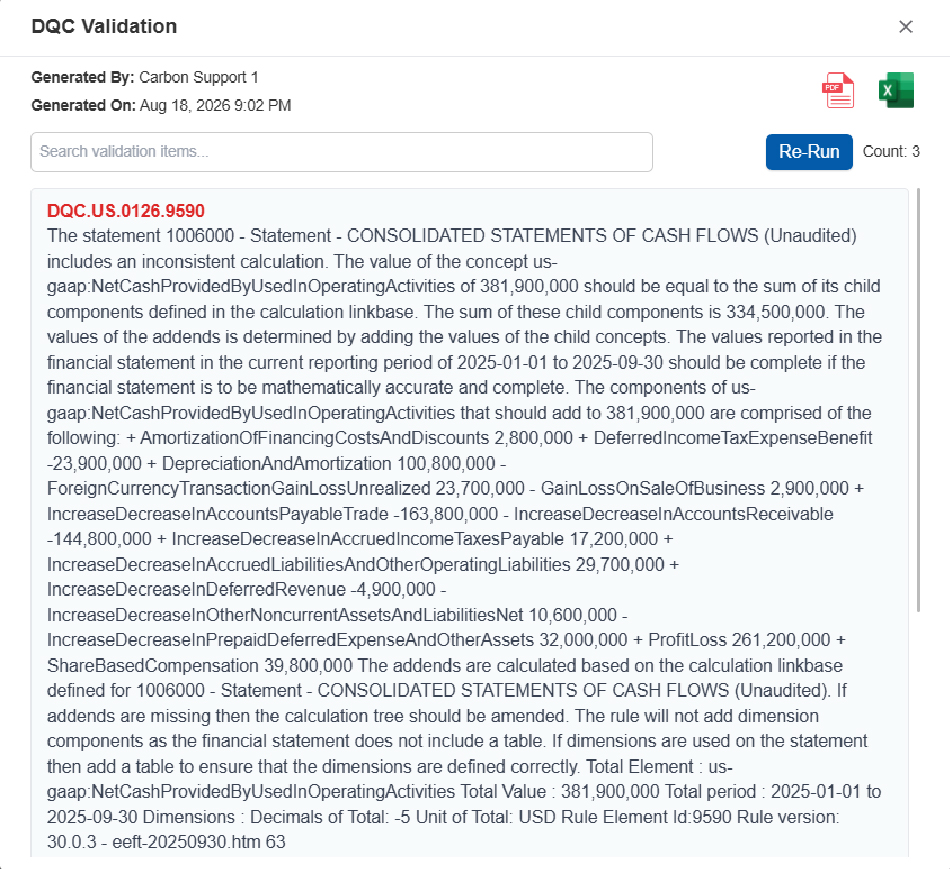
Get this wrong on one line item and the whole roll-up calculation for operating income stops reconciling. EDGAR throws a hard validation error the moment it tries to sum the numbers.

3. Required Values not Reported
About one in ten errors comes from a mandatory fact that simply never got tagged. This shows up most often in document and entity information tables or in footnote disclosures tied to specific transactions, derivatives, or business combinations. most often in document and entity information tables or in footnote disclosures tied to specific transactions, derivatives, or business combinations.
If the company discloses the transaction in the narrative but the corresponding required XBRL fact never gets attached, EDGAR flags the omission as a compliance breach, not a stylistic gap.

4. Date and Context Errors
Roughly comes down to confusing an instant fact with a duration fact. Balance sheet items are measured at a single point in time. Income statement items cover a period.
Mix those up, tag a duration-based context onto an instant concept, or misalign an opening balance date (using January 1 instead of December 31 of the prior year, for instance), and the taxonomy mismatch trips the validation engine.

5. Format Mismatches and Cross-statement Breaks
Two related problems round out the list:
- Scaling errors. The HTML shows a figure “in thousands,” but the underlying XBRL scale attribute gets applied incorrectly, so $14,520 in the presentation layer becomes $14,520,000,000 in the machine-readable dataset.
- Roll-up mismatches. A number gets updated in one place, say the balance sheet, but a related footnote reference doesn’t get the same update. The totals no longer tie across statements, and the calculation engine halts.
3 Workflow Gaps That Let iXBRL Tagging Errors Slip Past Experienced Teams
None of this is really about accounting competence. Seasoned reporting teams with deep technical knowledge run into the exact same suspensions as less experienced ones, because the root cause sits in the workflow, not in anyone’s understanding of GAAP.
A few patterns show up over and over:
| Disconnected Drafting and Tagging: Plenty of teams still draft in Word and Excel, then hand the near-final document to a filing agent for tagging. Every time a line item changes after that handoff, someone has to manually re-map the tags. That’s a lot of surface area for human error, and it all happens under time pressure. | Taxonomy Drift: The FASB and SEC update the standard taxonomy every year: new elements, deprecated concepts, revised calculation rules. Teams that don’t actively track those updates end up tagging with outdated elements or building invalid axis-member pairings without realizing the taxonomy moved out from under them. | Siloed Review Processes: In a lot of organizations, the accounting team reviews the printed PDF and the XBRL specialist reviews raw tag data, on two completely separate tracks. Nobody is looking at both layers at once. A fix made in the visual document doesn’t automatically get reflected in the data layer, and vice versa, so the two versions drift apart quietly until validation catches the gap. |
AI-Validated Tagging Catches Errors Before Submission, Not After
The fix isn’t “review more carefully” under the same time constraints that caused the problem. It’s moving tagging validation earlier in the filing cycle, so errors surface while there’s still time to fix them without panic.
This is where AI-assisted tagging validation is changing the workflow for reporting teams.
Instead of waiting for a final test filing to reveal problems, AI-based validation tools can check tags against current taxonomy libraries continuously as a document is drafted and flag errors the moment they’re introduced, not the night before submission. That turns tagging validation from a single high-stakes gate at the end of the process into an ongoing check that runs alongside every draft revision.
A few practices make this shift stick:
- Validate continuously, not just at submission. Run tagging checks against every material draft revision, not only the near-final version.
- Preview the rendered inline document, not just the raw tags. Confirming that the human-readable view and the machine-readable data actually agree catches drift that a tag-only review misses.
- Keep taxonomy libraries current automatically. AI-assisted tools that track FASB and IFRS taxonomy releases remove the burden of manually watching for deprecated elements.
- Separate the tagging review from the disclosure review. A dedicated pass focused only on tagging catches issues that get missed when reviewers are also proofreading language and numbers.
Core Comparison Matrix
| Cost / Risk Dimension | Traditional Filing Vendor | AI-Validated Software |
| Direct Cash Costs | High recurring page/tag fees + surcharges | Fixed platform subscription |
| Turnaround Time | Hours/days per review pass | Instant (real-time single-source rendering) |
| Late Draft Changes | High error probability (manual dual-track drift) | Zero drift (visual & data layer synchronized) |
| XBRL Validation | Batch check at end of cycle by vendor | Continuous background check on every draft |
| Audit & Legal Fees | High (re-reviews driven by late vendor fixes) | Low (errors resolved early without third parties) |
| Control Ownership | Partial dependency on third-party vendor operators | 100% in-house control over filing output |
📋 Resource: Is Your Filing Package Truly SEC-Ready?
Don’t wait for EDGAR to flag structural tagging errors or calculation breaks on filing night.
Download the XBRL Data Quality Scorecard to audit your team’s pre-submission process across US GAAP taxonomy alignment, dimensional axes, context rules, and Inline XBRL presentation consistency.
The Bottom Line
Last-minute filing delays almost always trace back to the same handful of tagging issues — invalid axis-member combinations, missing required values, date mismatches, negative value errors, custom tag overuse, format mismatches, footnote and segment errors, and cross-statement roll-ups that don’t tie out.
Together, the top few categories alone account for the majority of errors filers see. None of these are hard to catch. They’re just caught too late, because tagging validation happens at the end of the cycle instead of throughout it.
Moving that validation earlier with AI-assisted tools doing continuous checks instead of one final review is the difference between a filing that goes out cleanly and one that gets suspended the night before it’s due.