For SEC reporting teams, filing deadlines have always been a race against time. The final days before submission often become a cycle of manual reviews, reconciliations, and last-minute checks, where even a small inconsistency can trigger a regulator question, delay, or reputational impact.
That tension is what our recent webinar, “SEC Readiness in the Age of AI: What Reviewers Are Looking For,” set out to address. Instead of treating AI as some far-off buzzword, the conversation focused on something more immediate: how finance teams can move away from stressful, last-minute manual checks and toward validation that happens in real time, as the report is being built.
As the session opened:
“The regulators themselves are using AI to scan our filings. So, what is stopping us from building and validating our reports using AI?”
What the SEC Is Scanning For (And Why Manual Reviews Fall Short)
The SEC’s AI-powered review process runs through an enormous volume of filings every day, and it isn’t scanning at random. Regulators are checking for the same handful of things human reviewers have always chased, just faster and more consistently:
- Accuracy: Every number has to tie out, add up, and agree across the entire document.
- Consistency: Terms, units, currency, and language need to stay uniform across every section, so the MD&A narrative actually lines up with the financial statements and the footnotes instead of drifting into slightly different wording.
- Completeness & Prior-Year Agreement: Nothing required can be missing, and prior period figures need to carry forward correctly rather than quietly shifting year over year.
- XBRL Tagging Integrity: Inline XBRL tags have to be clean and consistent, not just present.
- Traceability: Every number needs a clear path back to where it came from, so it can be cross referenced without guesswork.
Missing the mark on any of these leads to costly comment letters, restatements, or reputational damage. But relying solely on human reviewers at the deadline leaves critical blind spots.
As Aakanksha Swaminathan, Functional Expert at IRIS CARBON®, put it:
“Accuracy, consistency, completeness, tagging, and traceability are the areas SEC reviewers are looking at, and they should be the areas we focus on as well.”
The 3 Pillars of an AI-Driven SEC Reporting Strategy
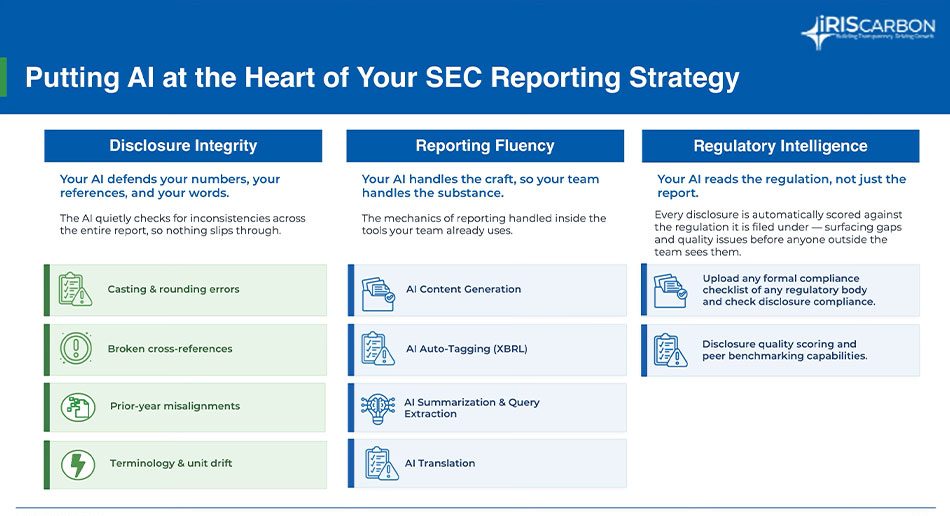
The webinar was careful to frame this as removing friction, not replacing judgment. Nobody’s suggesting AI should own the filing. But there’s a lot of repetitive, error-prone work sitting between a first draft and a submission, and that’s where an AI-driven strategy tends to break down into three areas.
1. Disclosure Integrity
Instead of conducting a massive manual review on the eve of a deadline, AI acts as a 24/7 continuous reviewer. It flags broken cross-references, casting discrepancies, and narrative mismatches as you write, allowing teams to resolve issues in real time.
“Continuous validation means AI is always reviewing your report, catching anomalies, and surfacing issues before they become last-minute surprises.”
Aakanksha Swaminathan
Functional Expert at IRIS CARBON®
2. Reporting Fluency
Starting from a blank page eats up valuable weeks. AI drafting tools ingest structured business inputs and historical filings to produce a clean first draft in seconds.
“With AI, you no longer have to start from a blank page. You can build on an intelligent first draft while keeping human expertise in the loop.”
Aakanksha Swaminathan
Functional Expert at IRIS CARBON®
3. Regulatory Intelligence
AI can read and evaluate disclosures directly against formal compliance checklists and SEC rules. It automatically scores disclosure quality, runs peer benchmarking, and surfaces potential regulatory gaps before external auditors or SEC reviewers see them.
“The biggest shift with AI is moving from fixing errors at the deadline to preventing them while you build the report.”
Aakanksha Swaminathan
Functional Expert at IRIS CARBON®
What AI Solves (And What It Must Guarantee)
While AI drastically cuts down cycle times and eliminates human fatigue errors, finance leaders must evaluate vendors carefully before adopting AI in their filing workflows.
Aakanksha stressed four critical evaluation criteria every finance leader must demand from an AI vendor:
- Data Protection & Isolation: Your sensitive, price-impactful financial data must remain isolated in your secure region and never be used to train public or external AI models.
- Auditability & Trust: Unlike general consumer AI tools that risk hallucinations or variable outputs, reporting AI must yield consistent, deterministic, and fully auditable results.
- Consistency & Determinism: Answers must strictly tie back to factual source data without speculative text generation.
- Workflow Integration: AI shouldn’t exist in an isolated silo; it must fit directly inside your disclosure management system where finance, legal, and audit teams collaborate.
From Early Adoption to Standard Practice
According to recent industry data, 92% of CFOs are already leveraging AI in their financial decision-making processes. What was considered experimental two years ago is now the baseline for operational efficiency.
“92% is a large percentage, which means these are not just early adopters anymore. In the past two years, AI has gone from ‘let’s test it’ to ‘let’s actually make it work.”
– Aakanksha Swaminathan
Functional Expert at IRIS CARBON®
By embedding AI capabilities directly into a unified disclosure management platform, finance teams can manage data sourcing, real-time drafting, XBRL auto-tagging, and EDGAR submission in one secure environment.