
Introduction
The European prudential reporting landscape is undergoing significant changes in 2026 with the implementation of CRR III and EBA 4.2.
As a part of the EU’s adoption of final Base III reforms (popularly known as Basel III-Endgame), banks and other financial institutions are expected to comply with enhanced supervisory reporting requirements.
At the same time, regulatory scrutiny across the EU banking sector continues to intensify.
EBA is driving greater transparency, harmonization, and data consistency through taxonomies, rules, and centralized prudential disclosures.
The industry trends are clear, where regulators are moving towards data driven supervision.
To combat the rising cost of compliance, EBA is targeting 25% reduction in reporting costs by eliminating redundancies and pushing for highly granular, machine-readable data through DPM 2.0.
For banks, 2026 is the year to transition from survival mode reporting to true reporting mastery.
Understanding CRR III
Capital Requirements Regulation III (CRRIII) is the latest EU update to the Basel III prudential rules for banks, replacing old versions (CR I & CRII) and entering 2025.
Its main goal is to strengthen the risk-based capital frameworks while limiting overall capital requirements increases and improving financial stability, ESG-risk integration and disclosure harmonisation.
Also, CRR III makes the internal ratings based (IRB) framework more restricted but attractive for partial adoption.
Key norms:
a. Credit Risk Standard Approach (CRSA) : CRR III refines the Standardised Approach to achieve more risk-adjusted capital backing through greater differentiation.
b. Output Floor: Internal model users now must compare their RWAs with those of CRSA; the higher of the two applies, with the standardised result capped at 72.5% of internal RWAs, phased in from 50% in 2025 to 72.5% by 2029.
c. Operational Risk Standardised Approach: All banks must use single, business indicator standardised method for operational risk, abandoning older internal model approaches.
d. ESG Risk and disclosure: CRRIII embeds explicit definitions of environmental, social, and governance (ESG) risks and requires banks to report ESG exposures and disclose related data.
Understanding EBA 4.2
EBA 4.2 is the version name of European Banking Authority (EBA) framework, that governs how banks and other supervised entities submit regulatory data to EU supervisors using XBRL taxonomies and DPM based structures.
EBA 4.2 modernises the EU’s reporting architecture, aligning with the new DPM 2.0 glossary to standardise definitions and improve data consistency across modules.
Key norms:
- Amended reporting modules: EBA revises requirements for resolution reporting, operational risk series, MREL related disclosure and Instant Payments (IPA) with standard templates.
- XBRL Upgrade: The framework uses EBA XBRL version 4.0 with taxonomy architecture version 2.0, which restructures elements so that validation rules are now part of both the taxonomy and DPM.
The Roadmap:
Below is a practical 2026‑ready timeline that banks can use to plan their data, governance, and technology readiness.
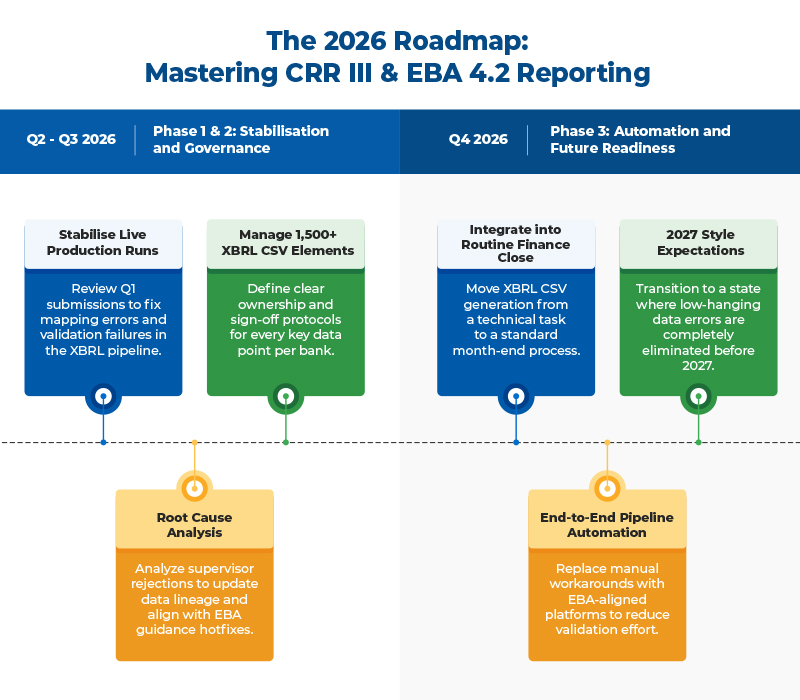
Phase 1: Stabilise What’s Live (Q2 2026 – Now)
Goal: Make current CRR III and EBA 4.2 submissions stable and repeatable
By this point in 2026, most banks have already submitted at least one round of CRR III disclosures and EBA 4.2 XBRL‑CSV reports. The priority now is to treat these as live production runs, not experiments.
- Review all Q1 2026 submissions (or the first official EBA 4.2 runs you’ve done) and document recurring issues: mapping errors, validation‑rule failures, and data gaps.
- Fix critical XBRL‑CSV mapping issues against the EBA 4.2 taxonomy and DPM 2.0, especially for COREP, FINREP, RESOL, OF, and IPA.
- Ensure that your CRR III capital‑risk calculations (CRSA, IRB output floor, operational risk standardised approach) are feeding a stable, auditable pipeline.
Phase 2: Improve Data Quality & Governance (Q3 2026)
Goal: Move from “working” to “good‑enough” data and controls
Once the pipeline is stable, shift focus from survival to quality and governance. This is where banks that rushed into 2026 reporting start to see supervisory feedback.
- Run root‑cause analyses of any validation errors or rejections from supervisors and update your data‑lineage documentation.
- Strengthen ownership of XBRL‑CSV elements (1,500+ per bank, in many cases) and define who owns, validates, and signs off on each key data point.
- Align with ongoing EBA guidance and hotfixes, such as revised validation rules and DPM‑2.0 adjustments, so your 2026‑Q3 reporting is cleaner than Q1.
Phase 3: Automate and Streamline (Q4 2026)
Goal: Turn manual workarounds into end‑to‑end automation
By Q4 2026, banks should be moving away from heavy manual intervention and toward semi‑automated or fully automated XBRL‑CSV pipelines.
- Integrate XBRL‑CSV generation into your standard month‑end/quarter‑end reporting cycle, so it is not a “one‑off technical task” but part of routine finance close.
- Use standardised templates and tooling (e.g., EBA‑aligned XBRL‑CSV platforms) to reduce manual mapping and validation effort.
- Prepare for 2027‑style expectations: supervisors will assume your 2026 experience has already cleaned up most of the low‑hanging problems.
Challenges Financial institutions face with EBA 4.2
Financial institutions face several challenges under EBA 4.2, especially those who are still using template reporting.
The new framework shifts from simple XML forms to DPM 2.0 with XBRL csv as the core format.
Many banks now struggle with the mapping of XBRL elements, frequent rule changes and last minute EBA fixes, all of which amplify manual rework and increases the risk of reporting errors.
| Traditional Approach | Modern Approach |
| Excel Templates | DPM 2.0 with XBRL csv |
| Cell, rows and columns | Defined Data points |
| Manual Rules | Machine readable rules |
How Regulatory Technology helps financial institutions with the new EBA 4.2 filings
Regulatory technologies can significantly streamline EBA 4.2 filings. They automate XBRLcsv generation, validation and mapping to DPM2.0, which helps in reducing manual work and error risk.
These platforms like IRIS iDEAL embed EBA rules, fixes and taxonomy updates centrally. So banks and other financial institutions can respond to EBA 4.2 changes without rebuilding it from step 1.
Conclusion
CRR III and EBA 4.2 mark a turning point in European prudential reporting. They move banks from static, template-driven exercises to a dynamic, data-driven regime built on DPM 2.0 and XBRL-CSV.
In 2026, the bar is no longer just about “complying on time.” It’s about submitting high-quality, consistent, and machine-readable data that regulators can actively analyse.
For financial institutions, this means treating each quarter not as a one-off filing. It means treating it as part of an ongoing cycle of data governance, automation, and continuous improvement.
The roadmap moves from stabilising live submissions in Q2, to improving data quality and ownership in Q3, to automating end-to-end reporting in Q4. It reflects the reality that legacy, Excel-based processes are no longer fit-for-purpose under EBA 4.2.
Regulatory technology plays a critical role here, enabling banks to embed EBA rules, taxonomy updates, and validation checks centrally.
However, changes can be absorbed quickly and with minimal manual rework.
Ultimately, 2026 is the year to transition from reactive survival mode reporting to proactive prudential reporting mastery.
Where accuracy, efficiency, and transparency become competitive advantages, not just regulatory hurdles.