
Introduction: Building Assurance in Your ESG Data
Building assurance is the process of turning aspiration into accountability. It signals that an organization is not only measuring its impact but also taking full responsibility for its truth.
ESG assurance matters because it turns narratives into evidence. It shows that behind every headline number (whether “Scope 1 emissions down 15%” or “gender-pay gap reduced to 5%”) there is a documented process, a clear data source, and a controlled workflow.
Why Companies Are Not Ready for ESG Data Assurance
Despite the growing importance of sustainability metrics, 75% of companies are NOT ready for ESG data assurance
The primary reason for this readiness gap is a fundamental lack of transparency and structural integrity within corporate data pipelines. Without traceability, ESG data remains siloed and vulnerable to errors, leaving organizations poorly equipped to back up their public claims.
The Transition Towards Reasonable Assurance
As we enter a period of unprecedented regulatory scrutiny, the “trust deficit” is widening. In fact, a recent survey by a leading firm revealed that 87% of investors suspect corporate sustainability reports contain unsupported claims.
To bridge this gap, the market is undergoing a high-stakes pivot: the transition from Limited Assurance to Reasonable Assurance.
While limited assurance is currently the most common practice, it only checks if data looks plausible on the surface, often missing deep structural errors. Basic checks leave heavy doubts about complex figures like emissions or Scope 3 data. True risk management requires deeper testing to protect businesses from lawsuits and severe reputation damage.
Understanding CSRD’s Assurance Requirements
The European Union’s Corporate Sustainability Reporting Directive (CSRD) is the primary force pushing companies globally toward reasonable assurance. Regulators worldwide are targeting greenwashing; for instance, the FTC (Federal Trade Commission) can penalize false claims, while the UK CMA (Competition and Markets Authority) can fine companies up to 10% of global turnover.
Under CSRD, ESG assurance is no longer optional. It represents a fundamental shift toward high-confidence ESG reporting comparable to traditional financial audits.
Key requirements:
| CSRD Requirement | Detail |
| Mandatory from Day 1 | Limited assurance required from the first year of CSRD application |
| Assurance Level | Limited assurance initially, transitioning to reasonable assurance |
| Timeline for Reasonable Assurance | By October 1, 2028 (after feasibility assessment) |
[source]
What Reasonable Assurance Demands
Reasonable assurance doesn’t promise perfection, but it does require rigorous, auditable evidence. To meet this standard, your organization must establish:
- End-to-end traceability from source systems to ESG dashboards and disclosures.
- Clear data lineage, documented assumptions, and defined ownership at every stage.
- A governed disclosure management process that controls versions, approvals and changes.
A Strategic Roadmap: Pivoting from Limited Assurance to Reasonable Assurance
Shifting your operations to support reasonable assurance requires a step-by-step evolution of your data and compliance workflows:
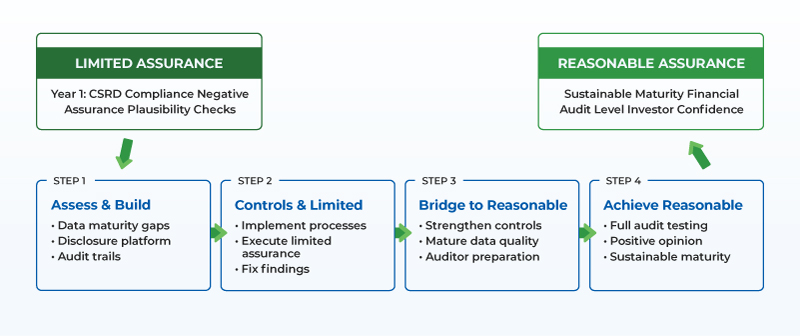
Start with Step 1 to assess gaps and build audit trails, move to Step 2 for controls and limited assurance fixes, bridge in Step 3 with better data quality and reach Step 4 for full testing and positive audit opinions.
The Role of Disclosure Management in Driving Data Assurance
Achieving this level of rigorous reporting requires two core capabilities working in tandem: Traceability and Disclosure Management.
- Traceability ensures that every ESG KPI is not just a number on a page but a verifiable outcome of a documented data pipeline. External reviewers can follow the data journey, increasing confidence in the reported impact.
- Disclosure management ties this traceability into the final reporting workflow, enforcing standards, version control, and approval gates so that what gets published is always aligned with internal systems and governance rules.
Together, they transform ESG assurances from a siloed, periodic exercise into a continuous, integrated layer of trust.