
For finance teams, the pressure of an SEC filing rarely comes from one big problem. It comes from dozens of small handoffs that pile up as the deadline nears: unfinished drafts, late judgment calls, manual consolidation, repeated reviews, tagging requests, and last-minute changes. By the time the 10-Q is ready to file, the team is often spending more time fixing and reconciling than reviewing what the numbers actually mean.
That was the focus of our recent webinar, “From Close to Disclosure: Streamlining SEC 10-Q with Automated Disclosure Management,” featuring Navneet Sharma, Partner, International Assurance & Advisory at KNAV US, and Aakanksha Swaminathan, Director, Finance Transformation at IRIS CARBON®.
The conversation looked at what happens between financial close and SEC filing, where reporting teams lose the most time, and how automation and AI can make the process more controlled, not just faster.
Why Q3 Is the Pivot Quarter
Q3 isn’t just another quarterly cycle, it’s the last full rehearsal before the 10-K. It’s the point where finance teams can still catch weaknesses in their close and reporting process before those problems get harder to fix at year-end.
The webinar identified four reasons Q3 matters: it’s the final dry run before the 10-K, technical accounting decisions surface early, the filing overlaps with year-end planning, and process gaps become visible.
“Q3 is where teams get real signal on their closing process and that signal only gets louder with time. Problems that show up now don’t resolve themselves; they compound heading into year-end. That makes Q3 the natural window to fix bottlenecks, tighten review workflows, and pilot new technology before the 10-K cycle begins.”
Aakanksha Swaminathan
Director, Finance Transformation
IRIS CARBON®

Where Reporting Processes Actually Break Down
Navneet, drawing on his experience as an auditor and advisor, pointed to two recurring failure patterns.
The first: information gets sent before it’s actually ready. An unfinished draft goes out for review, changes come back, and the same document cycles through multiple rounds. The second is nearly the opposite — the hardest, most judgment-heavy items get pushed to the very end of the process, arriving too late for proper resolution. Both patterns produce the same outcome: more review cycles, more rework, and less time to work through complex issues carefully.

The review cycle deserves more attention
One of the sharper points from the discussion: teams obsess over shortening the drafting stage but rarely apply the same discipline to review. Everyone asks “how do we draft faster?”, few ask how to make review more efficient.
Navneet’s warning was that an unmanaged review cycle can become the tail that stretches the entire filing timeline. Making a document faster to prepare doesn’t make the filing faster to finish, those are two different problems.
Where Rework Gets Expensive
Not every issue carries the same downstream cost. The webinar flagged four judgment-heavy areas where late decisions cascade into significant rework:
- Revenue – Performance obligations and variable consideration.
- Financial instruments – Classification and embedded derivatives.
- Impairment – Triggering events and documentation.
- Contingencies – New matters and developments.
A single change in conclusion in any of these areas can ripple across the financial statements, MD&A, risk factors, and other disclosures. The fix is a discipline, not a tool: identify → document → review → carry forward, applied at the moment the underlying change happens, not discovered as a year-end surprise.

A Shorter Checklist Can Beat a Longer One
The discussion pushed back on the assumption that a bigger checklist means better control.
Companies often maintain exhaustive disclosure and SEC reporting checklists running 300 pages covering every conceivable nuance, but so dense that teams get exhausted just filling them out.
| Navneet’s Recommendation: Keep the comprehensive checklist as your baseline, but build a shorter, company-specific checklist focused on what actually matters for your filing. And skip the yes/no format, every answer should capture why it’s true and which document supports it. |
Two Accounting Changes Finance Teams Should Start Preparing For
The webinar also looked beyond the current 10-Q cycle at upcoming accounting changes that will affect how companies collect, organize, and disclose financial information. The core message: these aren’t disclosure updates to deal with once the effective date arrives. Some will require finance teams to rethink how they capture information much earlier in the reporting process.
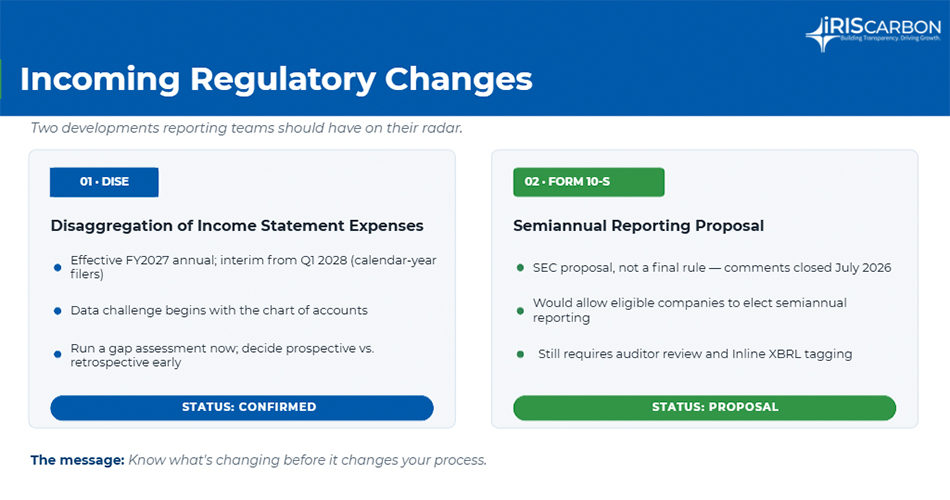
1. Disaggregation of Income Statement Expenses (DISE)
One of the major changes discussed was ASU 2024-03, commonly known as DISE, or Disaggregation of Income Statement Expenses.
The standard adds new disclosure requirements around expenses presented on the face of the income statement. Companies will need to provide more granular detail about what sits inside captions like cost of goods sold and selling, general, and administrative expenses.
The Critical Point: This isn’t a footnote you bolt on at the end of the cycle. As Navneet put it, DISE isn’t just a disclosure assembly exercise, it demands a fundamental change to how the underlying data is structured.
2) The Proposal to Move Toward Semiannual Reporting
The webinar also flagged a proposal to shift public companies toward semiannual reporting. It’s not a requirement yet, but it’s a development worth watching closely.
A change like this wouldn’t just mean fewer filings, it could reshape how teams manage the close and disclosure process all year round, from interim data and controls to how annual filings get prepared. For now, the right move is to monitor it, not build a compliance plan around it.
Together, DISE and the semiannual reporting (Form 10-S) proposal point to the same broader lesson: reporting teams need to watch not just what’s required today, but what could reshape the process tomorrow
“It’s not just a disclosure assembly point. It requires a fundamental change… What’ll be required is the companies are required to go over their chart of accounts, remap them and a lot of times ask for information differently from the ERP systems.”
Navneet Sharma
Partner, International Assurance & Advisory
KNAV US
XBRL: The Problem Is Timing, Not Just Tagging
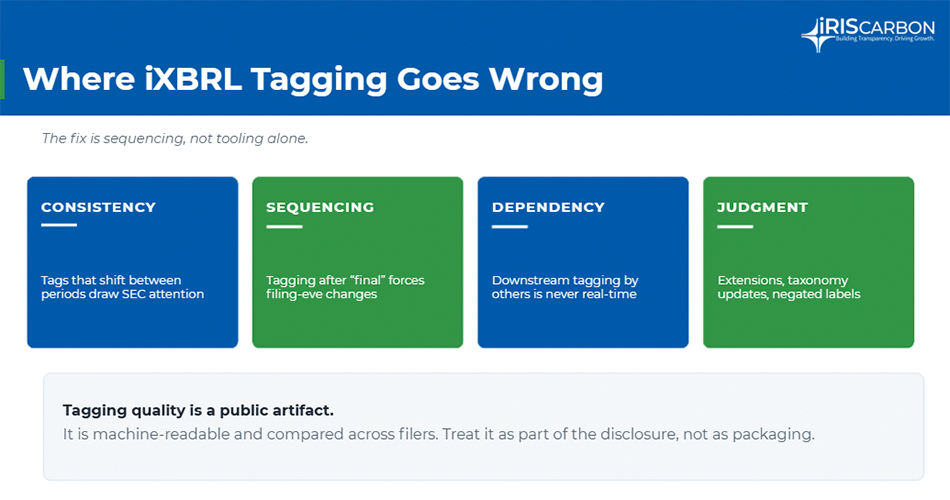
Outsourcing XBRL/iXBRL tagging and EDGARization to an external vendor can work well, but it also adds another handoff to an already compressed timeline. Navneet named four recurring risk areas in tagging: consistency, sequencing, dependency, and judgment.
- Consistency matters because a tag that changes from one quarter to the next can make filings look different even when the underlying disclosure hasn’t changed.
- Sequencing is the bigger structural issue, tagging is routinely left until the document is fully finalized and signed off, which turns it into a last-minute request with no time left for proper review.
- The larger point: XBRL isn’t a final formatting step. In a data-driven reporting environment, the tagged data itself is part of the disclosure.
Your 10-Q Should Tell One Story
Numbers can tie out perfectly and a filing can still read inconsistently.
Navneet described a common failure mode: the financial statements tell one story, the MD&A tells a similar-but-not-identical story, and another section of the filing tells something else entirely.
The fix is deliberate consistency, aligning the 10-Q with earnings materials, keeping language uniform across sections, reviewing roll-forward content on purpose (not by habit), and making sure legal and contingency disclosures match everywhere they appear.
Teams should also resist the instinct to carry forward prior-period language by default. Silence isn’t confirmation, a financial reporting team can’t assume nothing changed just because nobody flagged a change. That means actively asking the right people the right questions, rather than waiting to be told.

Where AI Actually Helps in SEC Reporting
The AI discussion stayed grounded. Navneet framed AI’s strongest current use case not as a replacement for judgment, but as a way to absorb mechanical work that consumes time without requiring human discretion. He grouped this into four areas:
- Drafting – Producing a first-pass narrative or document structure so teams start from something rather than a blank page.
- Detection – Flagging anomalies and supporting proofing and cross-footing, work that consumes disproportionate review time.
- Analysis – Checking financial information for completeness and simulating likely comment-letter questions.
- Comparison – Using public SEC EDGAR data for peer disclosure benchmarking.
The boundary is clear: AI is built for the mechanical layer, freeing humans to spend more time on judgment calls. Sign-off and accountability stay with people.

AI Can Write. People Still Have to Stand Behind It.
On the question of risk, Navneet’s answer cut both ways, the risk isn’t only in adopting AI carelessly, it’s also in not having an enterprise-controlled approach to it.
AI can write, but only a person can stand behind what it produces. That makes verification non-negotiable: finance teams need controls around AI-generated output, documented review mechanics, and evidence the review actually happened.
The same logic extends to the whole reporting process. Evidence of review isn’t just something auditors ask for, it’s part of the control environment itself. Without documentation, there’s effectively no proof the review took place.
Is Q3 the Right Time to Invest in AI?
Yes, and largely because Q3 offers a real testing window before year-end pressure hits.
Navneet’s View: AI is mature enough now for finance teams to start using it but adoption shouldn’t become its own bottleneck.
Prioritize tools that are easy and fast to implement over ones that require a six-month rollout; a new reporting platform, in his view, should realistically go live end-to-end in under four weeks.
The broader message from the webinar: treat Q3–Q4 as the implementation window, favor minimal disruption and familiar workflows, and keep data controlled with a clear review trail throughout.
The Bigger Takeaway: Fix the Process Before the Deadline Fixes It for You
The strongest thread running through the conversation wasn’t that AI makes SEC reporting faster, it’s that Q3 gives finance teams a chance to find where the process breaks before those weaknesses become year-end problems.

In practice, that means:
- Identify judgment areas early.
- Document changes as they happen.
- Build review into the process instead of leaving it for the end.
- Treat XBRL tagging as part of the workflow, not a last-minute handoff.
- Keep the filing narrative consistent across every section.
- Use AI for mechanical work, drafting, detection, analysis, comparison.
- Keep human judgment and sign-off at the center.
- Maintain evidence of review and control.
Technology can compress the mechanical work. It can’t replace accountability. And as Navneet noted, today’s approach to AI won’t necessarily be tomorrow’s, the landscape keeps moving. The most practical mindset may simply be this: don’t wait for the technology to stop changing. Build a reporting process that can evolve with it.


