
For years, risk teams focused on clear threats: market shifts, cyberattacks, and financial fraud. They used controls, insurance, and software to reduce those risks. Now a new, serious threat has emerged: greenwashing, where organizations tend to fabricate facts to present a refined picture of their business to garner investor attention and build societal reputation. What used to be a PR headache, has become a legal and financial hazard. Regulators now treat ESG disclosures more like financial statements, and companies must respond accordingly.
A vague or exaggerated sustainability claim can no longer be dismissed as a communications mistake. Enforcement agencies, prosecutors, and plaintiffs’ lawyers are taking action. Rules like the SEC’s climate guidance and Europe’s CSRD are making ESG reporting mandatory, consumer protection bodies are pursuing misleading product labels, and shareholder activists are suing directors over deceptive sustainability statements.
The practical risk is huge:
- One unverified metric can trigger investigations, class actions, and severe market fallout.
- If you can’t trace an ESG figure back to its primary source with a clear audit trail, you’re holding an unhedged liability, not managing a program.
Treating Reasonable Assurance Software as Digital Insurance
When you can’t remove a risk, you hedge or insure it. Reasonable Assurance Software should be viewed the same way: a structural shield against legal and financial exposure, not just another compliance cost.
This software directly combats greenwashing by enabling end-to-end traceability, capturing every data source from a factory electricity bill to a supplier manifest, and recording every calculation and aggregation along the way.
How it defends you
- Strong data provenance and traceability
Litigators exploit ambiguity. The best defense is an indisputable chain of custody. The software captures every data source (from a factory electricity bill to a supplier manifest) and records every calculation and aggregation. If challenged, you can produce an immutable audit trail.
- Removes the “we relied on vendor data” excuse
Regulators won’t accept ignorance. The software enforces internal controls, anomaly detection, and continuous validation. That shows you acted deliberately to ensure accuracy, which weakens claims of negligence or intent to deceive.
- Protects executives and boards
Directors and officers now face personal exposure for false disclosures. Reasonable Assurance Software builds governance into the workflow: validation gates, sign-offs, and evidence required before any report is released. That gives leaders defensible confidence in what they approve.
The Missing Link: Disclosure Management as the Last Line of Defense Against Greenwashing
Even perfect data can be misrepresented in the final report. A correct number framed misleadingly or stripped of nuance can trigger enforcement. That’s why disclosure management is critical.
How disclosure management prevents greenwashing:
- Single source of truth: Prevents scattered spreadsheets and unauthorized drafts. Legal, IR, sustainability, and marketing work from the same verified document.
- Built-in legal and regulatory checks: Narrative text tied to metrics must pass formal review within the system, so context and qualifiers aren’t lost.
- Audit trails: Every edit, author, and approval is logged, enabling accountability for every sentence.
Disclosure Management: 3-Step Protection Flow to Make ESG Data Trustworthy
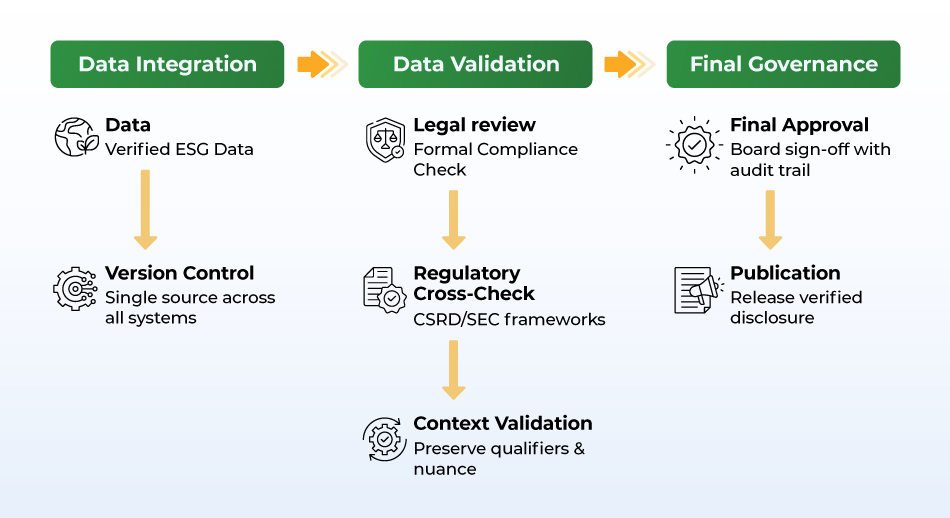
This process closes the gap between fact and public perception, removing the ambiguity that plaintiffs exploit.
When put another way: reasonable assurance secures the data; disclosure management protects how you present it. Together, they close the gap.
Moving from Exposure to Resilience
Greenwashing is, at its core, a risk-management failure. Treating sustainability as marketing invites catastrophic legal and financial consequences.
In today’s environment, deploying Reasonable Assurance Software alongside a strict disclosure management system isn’t optional, it’s a fiduciary duty. Think of these tools as corporate insurance that establishes verifiable credibility and long-term trust.
- Eliminates Data Chaos = Stronger Data Provenance
Consolidation of all scattered spreadsheets and unauthorized drafts into one verified document.
- Enforces Compliance Checks = Prevents Misleading Narratives
Ensuring all narrative text tied to ESG metrics passes formal legal and regulatory review within the system before publication.
- Creates Text-Level Audit Trails = Defensible Board Sign-Off
Logging of every edit, author, and approval for every sentence in public disclosures.