
For many European issuers, the most demanding part of the European Single Electronic Format (ESEF) reporting process begins after the financial statements are already finalized.
The numbers are approved.
The annual report design is complete.
Management sign-off is done.
What remains is converting the finished report into a fully tagged Inline eXtensible Business Reporting Language (iXBRL) document that complies with European Securities and Markets Authority (ESMA) requirements.
This is where many reporting teams encounter what can be called the last-mile problem in ESEF reporting.
As digital reporting requirements grow more complex, AI-assisted tagging for ESEF is emerging as a practical way to reduce manual effort, improve tagging accuracy, and keep filings on schedule.
Why the Last Mile of ESEF Reporting Is the Most Challenging
The structure of most reporting workflows unintentionally pushes ESEF tagging to the final stage of the process.
A typical sequence looks like this:
| Financial statements are finalized | The annual report is designed and formatted | Management approvals are completed | Only then does ESEF iXBRL tagging begin |
Common Last-Minute ESEF Tagging Problems
When tagging begins late in the reporting cycle, several recurring challenges tend to appear.
1) Finding the Right Taxonomy Tags
The ESEF taxonomy tagging process requires mapping each relevant disclosure to the closest matching taxonomy element.
For reporting teams working under deadline pressure, navigating thousands of taxonomy elements can be time-consuming.
Even experienced users may spend significant time searching for the most appropriate tag for specific financial statement line items or note disclosures.
Misidentifying a tag can also lead to review cycles later in the process.
2) Extension Creation and Anchoring
When the standard taxonomy does not include a suitable element, companies must create a custom extension.
However, extensions cannot exist in isolation.
They must be anchored to the closest broader or narrower taxonomy element, ensuring the disclosure remains comparable with other filings.
Incorrect or incomplete anchoring can trigger validation errors and regulatory scrutiny.
For organizations new to ESEF iXBRL tagging, managing extensions and anchors often becomes one of the most technically demanding aspects of the process.
3) Validation Errors Before Filing
Before submission, reports must pass multiple technical validation checks.
Common issues include:
- Incorrect taxonomy element selection.
- Missing contexts or dimensions.
- Incorrect extension anchoring.
- Structural inconsistencies in tagged tables.
- Duplicate or conflicting elements.
These validation failures often appear late in the process, forcing teams to troubleshoot issues while the filing deadline approaches.
4) Coordination Between Teams
ESEF reporting rarely involves a single team.
Finance, financial reporting specialists, external consultants, and sometimes design agencies may all be involved in producing the final annual report.
In many cases, work happens across Excel spreadsheets, Word documents, and reporting platforms.
This fragmented workflow can make it difficult to track changes, maintain version control, and ensure the final tagged report accurately reflects the approved financial statements.
How AI-Assisted Tagging Helps Solve the Last-Mile Challenge
Advances in AI in XBRL reporting are beginning to address many of the operational challenges associated with manual tagging.
Rather than replacing human oversight, AI tools support reporting teams by accelerating the tagging process and reducing the risk of common errors.
1) Intelligent Tag Suggestions
Rather than requiring users to manually search through thousands of taxonomy elements, AI-assisted tagging systems can analyze the content of financial statements and recommend relevant ESEF taxonomy elements based on the disclosure context.
This significantly reduces the time required to locate appropriate taxonomy elements.
2) Faster Mapping to the ESEF Taxonomy
AI models trained on previous filings can identify patterns in how similar disclosures have been tagged across historical reports.
This allows ESEF tagging automation tools to recommend taxonomy mappings that align with common reporting practices, helping users make faster and more consistent tagging decisions.
For organizations with recurring disclosures across reporting periods, this capability can substantially accelerate the tagging process.
3) Improved Tagging Consistency
Consistency is a persistent challenge in ESEF reporting, particularly across long, complex financial statements.
When similar disclosures are tagged differently across sections of a report, it can create confusion for regulators and data users.
AI-assisted tagging helps maintain consistent taxonomy usage by recommending the same elements for comparable disclosures across the financial statements.
This improves the overall quality of structured data within the filing.
4) Reduced Review Cycles
Manual tagging often leads to multiple internal review cycles, particularly when errors or inconsistencies are identified late in the process.
By improving the accuracy of initial tag selection, AI-assisted tagging for ESEF can reduce the number of corrections required during review.
For finance leaders managing tight reporting schedules, fewer review cycles translate directly into faster filings and lower operational risk.
Simplifying ESEF Tagging with IRIS CARBON®
AI-assisted tagging delivers the most value when it is integrated into a broader ESEF reporting software environment.
Modern reporting platforms combine several capabilities that streamline the end-to-end digital reporting process.
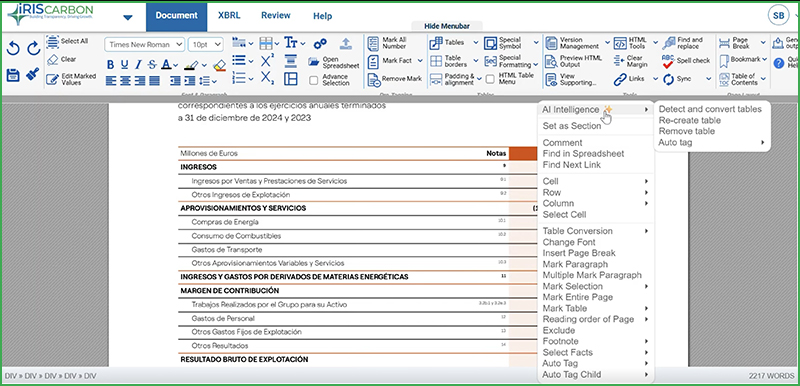
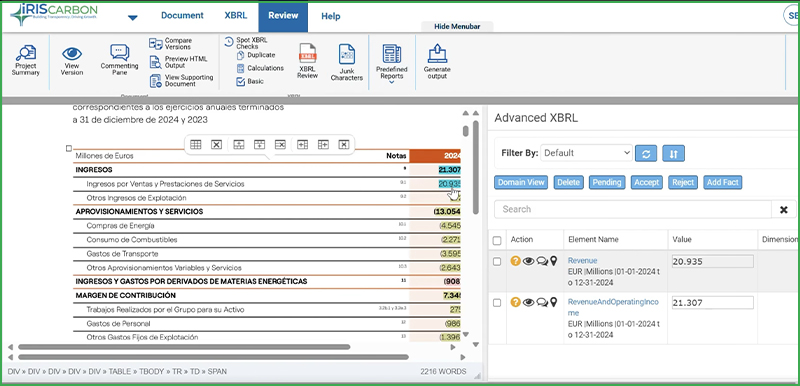
Platforms like IRIS CARBON® combine AI-assisted tagging with a built-in XBRL tagging environment. The IRIS CARBON® ESEF Reporting platform helps finance teams convert annual reports into ESEF-compliant iXBRL filings while simplifying the tagging process.
Key capabilities include:
- AI-assisted tagging that analyzes financial statement disclosures and suggests relevant ESEF taxonomy elements.
- Built-in XBRL tagging environment that allows teams to tag disclosures directly within the document.
- Automatic table detection and tagging, making it easier to structure and tag financial statement tables.
- Extension and anchoring support to ensure custom elements comply with ESEF taxonomy requirements.
- ESMA-aligned validation checks to identify tagging or structural issues before filing.
By combining ESEF tagging automation, AI-driven suggestions, and built-in validation, IRIS CARBON® helps finance teams complete filings faster, reduce last-minute errors, and maintain better control over their ESEF reporting workflow.
Preparing for the Future of Digital Regulatory Reporting
ESEF is not an isolated requirement. Regulators across European markets continue to expand structured data reporting obligations, and the direction of travel is clear: more disclosures, more granularity, and more emphasis on machine-readable data. The skills and tools that finance teams develop for ESEF tagging today will be directly relevant to future reporting requirements.
Structured reporting is expanding across global regulatory frameworks.
As regulators place greater emphasis on machine-readable financial data, the complexity of tagging and validation requirements is likely to increase. For finance and reporting teams, this makes automation and AI-enabled tools increasingly important.
Adopting smarter approaches to ESEF taxonomy tagging can help organizations:
- Complete filings more efficiently.
- Reduce the risk of validation failures.
- Improve the accuracy and consistency of tagged data.
- Scale digital reporting processes as requirements evolve.
For many issuers, the goal is no longer just meeting the filing deadline. It is building a reporting process that can support the growing demands of structured regulatory disclosure.