Every quarter, the same scramble happens in finance departments across the US. Numbers get pulled from the ERP, pasted into spreadsheets, and copied into Word drafts. Then they are tagged in XBRL (eXtensible Business Reporting Language), reviewed by five people, and re-checked when a late adjustment lands two days before the deadline.
In 2026, that process is harder to justify. The regulatory calendar is shifting, and AI has moved from pilot projects into daily finance work. Modern SEC reporting software can now handle a large share of the mechanical work that used to eat up your team’s close cycle.
This guide covers what’s changing in 2026, which parts of SEC reporting you can realistically automate, how to choose the right SEC reporting tools, and where human judgment still has to stay in the loop.
Why Legacy SEC Reporting Is Hitting a Wall
For years, most compliance teams have worked the same way. Pull data from the ERP, paste it into a static spreadsheet, drop it into a Word draft, and format the footnotes by hand. It gets the job done, but it creates predictable problems:
| High Risk of Restatements:
Every manual copy-paste is a chance for a wrong number to slip in, and those chances multiply in the final days before a deadline. |
Collaboration Silos:
Legal, external auditors, the CFO, and accounting often end up working in separate documents. This makes it easy for teams to work from different versions of the same document. |
The XBRL Burden:
Tagging financial statements in XBRL by hand is slow and technical, and one small mistake can trigger validation errors in the SEC’s automated checks. |
What Is Changing in SEC Reporting in 2026?
SEC Semiannual Reporting Proposal: Form 10-S vs. Form 10-Q
The biggest news this year is a possible change to the reporting calendar. On May 5, 2026, the SEC proposed letting public companies file semiannual reports on a new Form 10-S instead of quarterly 10-Qs. The 10-S would be due 40 or 45 days after the first half of the fiscal year, depending on filer status.
It isn’t a one-time choice. Companies would elect it by ticking a box on the 10-K cover page, and anyone who wants to stay semiannual has to tick it again every year. You could still put out quarterly earnings releases.
The practical point: Your reporting process may need to run on a quarterly or a semiannual rhythm, and switch between the two. Spreadsheet workflows built around four fixed cycles won’t handle that well. Template-based SEC reporting software handles it much more easily.
EDGAR Next: Stricter SEC Filing Access and Security
EDGAR Next changed how you get into the system. Filers now sign in through login.gov with multi-factor authentication, and access is role-based with designated account administrators. Section 16 filings also have to be tied to individual Login.gov accounts.
That turns user management into a filing risk. If your list of authorized users is out of date, a submission can fail on deadline day, and the SEC counts that as late, regardless of the reason.
The Real Cost of Late SEC Filings
Late filings carry real consequences. They can affect Form S-3 eligibility, trigger deficiency notices from Nasdaq or the NYSE, and lead to SEC comment letters or enforcement referrals. When making the case for automation internally, focus on reducing filing risk and protecting compliance, not just on saving time.
AI Adoption in Finance and SEC Reporting
Most finance teams have already started using AI. According to a research, 67% of finance professionals are using or piloting it. But adoption does not always translate into measurable results. In a 2026 survey, only 21% said their AI projects had delivered meaningful, measurable results, while 64.8% described the outcomes as mixed or unsuccessful.
The pattern is familiar. Teams buy a tool, point it at a messy process, and get messy results. SEC reporting is a better target than most because the work is repetitive, rules-driven, and has hard deadlines. It still needs the right groundwork, though.
How the SEC Uses AI to Review Filings
Most people picture analysts, investors, and an SEC staff reviewer reading their 10-K. Today, software is often the first reader, including tools used by the SEC.
The SEC AI Task Force and Chief AI Officer
In August 2025, the SEC set up an AI task force led by Valerie Szczepanik, its Chief AI Officer. Its stated purpose is to give staff AI tools that expand what they can handle, speed up their workflows, and make the agency’s regulatory and enforcement work more accurate and timely. The SEC also expects these tools to help staff spot issues for rulemaking and enforcement more quickly.
SEC Data Analytics and the EPS Initiative
The SEC has been using data to find reporting problems for a while. Its Division of Enforcement set up the EPS Initiative, which uses risk-based analytics to find accounting and disclosure violations, including earnings management meant to hide weak results.
It has produced cases. In the first three, each company had a run of quarters where it met or barely beat analyst EPS estimates, followed by a steep drop. The companies paid more than $12 million in penalties combined, and individual officers were fined and temporarily barred from practicing before the Commission as accountants.
The lesson is uncomfortable but useful. A pattern in your numbers can draw attention even when every individual number looks fine. AI makes finding those patterns faster and cheaper, which means more companies can be screened.
Why XBRL Data Quality Matters for SEC Review
Every 10-K and 10-Q includes Inline XBRL (iXBRL), which turns your financial statements into machine-readable data. Each number is tagged individually and can be traced back to its source. The SEC publishes this data through free APIs, and it’s only as accurate as the tagging the filer does.
So, a wrong tag, a tag that changes from one period to the next, or an unnecessary custom tag doesn’t just annoy data vendors. It affects how your company looks to any system comparing you with peers or with your own history, and that includes systems at the SEC.
SEC Scrutiny of AI Disclosures in 10-K Filings
The SEC is also watching what companies say about AI. The Division of Corporation Finance has been sending comment letters on AI disclosures since 2021 and keeps pushing back on vague language. AI is on the Division of Examinations’ 2026 priority list as well, and staff are checking that companies’ descriptions of their AI capabilities hold up. In 2024 the SEC charged two investment advisers over false claims about their use of AI.
Put simply, if the regulator reviews your filing with machines, you should review it that way first.
Which SEC Reporting Tasks Can You Automate?
Some of the work should be automated and some shouldn’t. Here’s a realistic view:
| Task | Automation potential | What it looks like in practice |
| Pulling data from the ERP or other sources | High | Direct integrations feed trial balance data into your templates |
| Roll-forwards and tie-outs | High | Change a number once and it updates everywhere |
| XBRL tagging and validation | High | Tags carry over from prior periods; AI suggests and checks new ones |
| Filing calendar and task tracking | High | Deadlines set by filer status, with reminders and approvals |
| Pre-filing anomaly and consistency checks | High | AI flags odd patterns, mismatched figures, and broken cross-references |
| First drafts of MD&A and footnotes | Medium | AI drafts variance explanations; your team edits them |
| Disclosure checklists and peer benchmarking | Medium | AI spots missing items and compares your wording with peers |
| Materiality calls | Low | Stays with management, the audit committee, and counsel |
| Final sign-off and certifications | None | SOX 302 and 906 certifications stay with the CEO and CFO |

AI-Powered Disclosure Management: The Smarter Way to Automate SEC Reporting
What Is Disclosure Management Software?
Disclosure management software is a single workspace where your finance, legal, and compliance teams build SEC filings together. Instead of a trail of spreadsheets, Word files, and email attachments, the whole report lives in one place. Numbers come in from source systems, narrative sits alongside them, and XBRL tagging is part of the same document rather than a separate step at the end.
The core idea is simple. Every figure exists once. When the controller updates revenue in the source workbook, the change flows into the income statement, the MD&A table, the footnote, and the XBRL tag at the same time. No one has to hunt for the other places where that number appears.
Why AI Belongs Inside Your Disclosure Management Platform
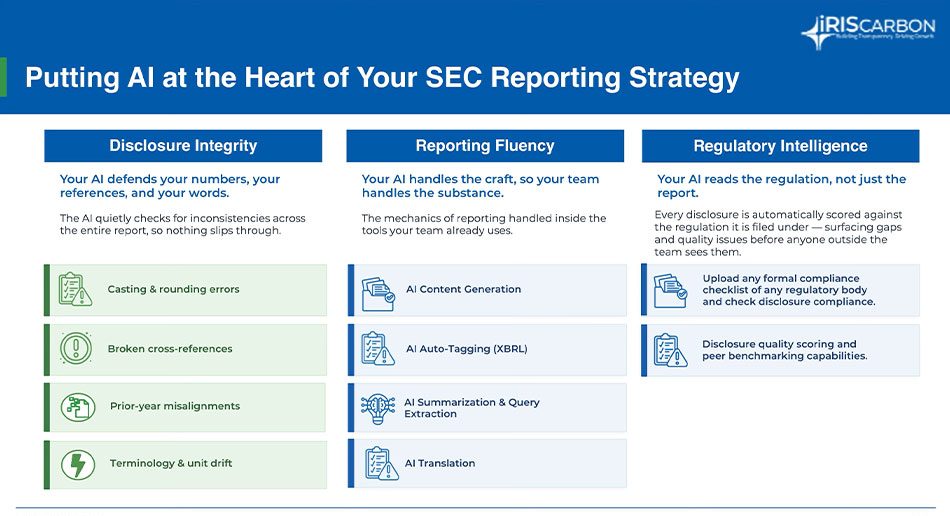
Here’s where many companies go wrong. They keep a manual reporting process and add a generic AI chatbot on top. The AI has no idea which version of the draft is current, where a number came from, or how it was tagged last quarter. It can’t give reliable answers because it has no reliable context.
When AI sits inside a disclosure management platform, it has that context. It can see the linked data, the tagging history, the review trail, and the rules the filing has to meet. That’s what makes AI useful for SEC reporting rather than just interesting.
What AI-Powered Disclosure Management Does for SEC Reporting
A good AI-powered disclosure management platform should cover the following:
- Single Source of Truth: Your source systems, financial statements, notes, and narrative are all linked. Change a number once and it updates everywhere it appears.
- AI Content Generation and Summarization: AI writes a first draft of your commentary and summarizes long reports so executives can review them quickly. As you write, it also keeps checking:
- Cross-References between the statements and the notes.
- Prior-Year Alignment, comparing your draft with what you filed before.
- Terminology and Units, so terms and figures are used the same way in every section and table.
- Narrative Continuity, so MD&A, the financial statements, and the risk factors all tell the same story.
- Real-Time Validation: Disclosures and XBRL tags are checked against SEC rules while you work. You find problems before you submit, not after a rejection.
- Anomaly and Consistency Checks: Unusual patterns, figures that don’t match, and broken cross-references get flagged while you’re still drafting.
- Collaboration and Approvals: Finance, legal, IR, and audit work in the same document. Each section has a clear owner, and sign-offs happen digitally.
- Full Audit Trail: Every change is recorded with the time, the user, and the value it replaced. Auditors and SOX testers can see exactly what happened and when.
- Adobe InDesign Integration: Your designed annual report and proxy statement pull from the same data as the filing, so the printed version always matches what you sent to the SEC.
- Disclosure Quality Scoring: Each section gets a score against regulatory expectations, which shows reviewers where to focus their time.
- Peer Disclosure Analytics and Benchmarking: You can compare your disclosures with peer filings and catch language that is too vague or doesn’t match industry practice.
- Direct EDGAR Submission: Filings go straight from the platform to the SEC. No manual conversion and no passing files between teams.
If you’re weighing your options, IRIS CARBON® is worth a look, because it brings every capability listed above into one platform. It’s built on Microsoft 365, so your team keeps working directly in Word and Excel while updates sync across everyone’s file.
How to Automate SEC Reporting: 6 Steps for Finance Leaders
Step 1: Map Your Current SEC Reporting Process
Before you look at any SEC compliance software, follow one Form 10-K or 10-Q from start to finish. Write down every handoff, every spreadsheet, and every place a number gets typed in by hand. Most teams are surprised by how much time goes to reconciling versions and chasing tie-outs instead of analysis.
Look closely at:
- Where does data leave a system of record and land in a spreadsheet?
- How many people touch each number before it reaches the filing?
- How long do reviews take, and where do they get stuck?
- How late adjustments get pushed through the document?
Step 2: Build a Clean Data Foundation for SEC Compliance
This is the step teams skip, and it’s usually why AI projects stall.
The problem is rarely a shortage of data. According to a study, only 10% of organizations say a lack of data is their main barrier to adopting AI. The real obstacles are readiness, access, and trust. The most-cited challenges are data silos (54%), security and privacy concerns (48%), format inconsistencies (46%), weak data management and governance (46%), and an unclear data strategy (45%).
Get the basics right first: a clean chart of accounts mapping, consistent entity structures, and one source of truth for every number that ends up in a filing. As a bonus, clean data produces clean XBRL, which is what machine reviewers read.
Step 3: Choose the Right SEC Reporting Software
The most important feature in modern SEC reporting software is linked data. Each number lives in one place and flows into the financial statements, the footnotes, MD&A, and the XBRL tags. Change it once and everything updates.
When you’re comparing SEC reporting tools, ask vendors:
- Integration: Does it connect directly to your ERP and consolidation system, or does it rely on file uploads?
- Collaboration: Can legal, tax, IR, and the controller’s team work in the same document at once, with version history?
- XBRL/iXBRL: Is iXBRL tagging built in, and does it validate against the current taxonomy and your prior tags?
- EDGAR: Can you file directly, and does it support EDGAR Next’s role-based access?
- Flexibility: How quickly can templates change if you switch to semiannual reporting?
- Audit trail: Does it log every change with who made it, when, and what the value was before?
- Security: Can the vendor provide SOC 1 and SOC 2 reports, and will the tool fit your SOX controls?
Step 4: Use AI Tools to Automate SEC Compliance Workflows
Once your data is clean and your platform is in place, AI can take on the time-consuming work. Several of these uses mirror the checks a regulator’s tools might run on your filing.
With clean data and the right platform, AI can handle anomaly detection, content generation, summarization, and cross-referencing.Step 5: Build SOX Controls Around SEC Reporting Automation
Automation doesn’t remove your SOX obligations. It changes what the controls look like. Document how each automated step works, who reviews AI-generated content, and how you check the output. Your auditors will want to know how AI is governed in your reporting process, so bring them in early.
A simple rule helps: AI can draft, flag, and suggest, but a named person approves everything that goes into a filing.
Step 6: Pilot Your SEC Filing Software, Then Scale
Don’t try to automate everything at once. Start your new SEC filing software on a 10-Q or your Section 16 filings. Track the hours saved and the errors caught, fix what doesn’t work, and then move on to the 10-K and proxy. Your team will build confidence on lower-stakes filings first.
What SEC Reporting Tools Can’t Replace: Human Judgment
Some things no SEC compliance software can do. It can’t decide what’s material. It can’t choose how to explain a tough quarter to investors. And it can’t sign the filing. The CEO and CFO certifications under Sarbanes-Oxley are personal for good reason.
The finance teams doing this well aren’t the ones that have automated the most. They’ve automated the repetitive work so their people have time for judgment, narrative, and strategy.
Final Thoughts on Automating SEC Reporting in 2026
SEC reporting is changing quickly. The filing calendar may shift, EDGAR access is stricter, AI is part of everyday finance work, and the SEC is reviewing filings with better tools than ever. A manual, spreadsheet-driven close gets harder to defend every quarter.
Start by mapping your process and cleaning up your data. Choose SEC reporting software built on linked data, and use AI where it removes real friction. Check your filing the way a machine reviewer would, and keep people accountable for every judgment and every signature. Do that, and your team spends less time reconciling numbers and more time explaining what they mean.
What’s Next for SEC Reporting in 2027
2027 is expected to bring more flexibility for filers, and higher expectations for data quality.
- Form 10-S and Semiannual Reporting
The SEC has proposed letting public companies file semiannual reports on a new Form 10-S instead of quarterly Form 10-Qs. For calendar year-end companies, the election on the fiscal 2026 Form 10-K would apply to 2027 reporting. - Filer Status Simplification
A second proposal would reduce five filer categories to two and raise the large-accelerated filer threshold from $700 million to $2 billion. That would extend scaled disclosure relief to an estimated 81% of reporting companies. - 2027 XBRL Taxonomy Updates
Expect continued focus on XBRL data quality: precise element mapping, fewer custom extensions, and XBRL review built into the close. - Integrated Risk Disclosure
Risk disclosures are moving toward clearer links between operational risks and the numbers in the financial statements.
SEC Reporting Software FAQs
What Is SEC Reporting Software?
It’s a platform that helps public companies prepare, review, tag, and file reports such as the 10-K, 10-Q, 8-K, and proxy statement. Most combine linked financial data, shared drafting, XBRL tagging, and EDGAR filing in one place.
Does the SEC Use AI to Review Filings?
The SEC set up an AI task force in 2025, led by its Chief AI Officer, to bring AI tools into its work, including work that supports enforcement. It has used risk-based data analytics for years to flag possible accounting and disclosure problems. It hasn’t published exactly how AI is used in individual filing reviews, but it’s safest to assume your XBRL data and disclosures can be read and analyzed by machines.
Can AI Write a 10-K?
AI can draft parts of it, especially variance commentary and routine disclosures, and it can check drafts for gaps and inconsistencies. It isn’t the author. Management is responsible for what the filing says, and people have to review everything AI produces.
How Does Semiannual Reporting Affect SEC Reporting Automation?
If the SEC adopts the proposal, companies could choose quarterly or semiannual reporting each year. Automated, template-based reporting makes switching between the two much easier than a manual process does.
How Long Does It Take to Implement SEC Reporting Tools?
It depends on how complex your data is and how many filings you include. Most companies roll out in phases, starting with one quarterly filing and building up to the full annual cycle over a few reporting periods. Tools like IRIS CARBON can take as little as four weeks.